Fareed the Fabian.
When Zakaria’s Piece Does Not Fit.

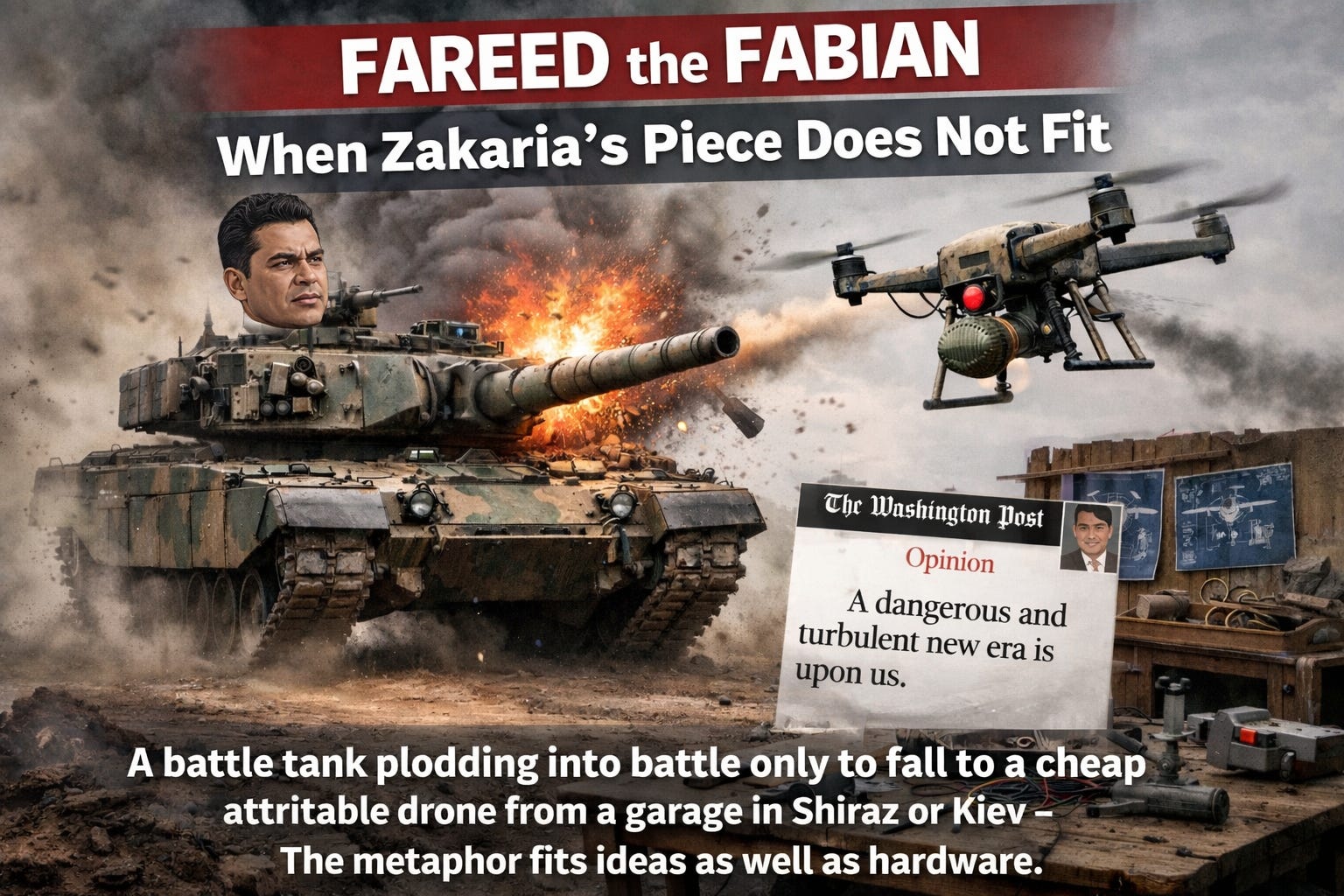
Fareed Zakaria’s recent column in The Washington Post identifies a genuine transformation in the economics of conflict. Low-cost attritable systems (drones and loitering munitions assembled for tens of thousands of dollars) now impose disproportionate losses on platforms costing millions, inverting the classic cost-imposition logic of post-Cold War supremacy (Zakaria, 2026). The observation is acute. Yet the frame that “the future of war is arriving faster than most imagined” is misleading. It remains tethered to an obsolete paradigm that Graham Allison’s Thucydides Trap and John Mearsheimer’s offensive realism had already failed by early 2026. Zakaria thus emerges as the Fabian of contemporary commentary: cautious and incremental, advancing with deliberate authority only to discover his piece no longer fits the material realities of the technological age.
Allison predicted that a rising power’s challenge to a hegemon would spark structural fear and pre-emptive war (Allison, 2017). Mearsheimer reinforced this view: states maximise relative power in anarchy through territorial conquest and platform dominance (Mearsheimer, 2001). Both dominated Western international relations for decades but failed spectacularly. By February 2026, with the United States entangled in multiple theatres and munitions depleted across Ukraine, the Red Sea, the Caribbean and the Indo-Pacific, the true dynamic was not Thucydidean collision but Koch’s Spider Trap (Koch, 2026b). A rising power need not launch missiles across the Taiwan Strait. Sustained pressure on material requisites (rare-earth elements, permanent magnets, semiconductor ecosystems and precision manufacturing chains) erodes replenishment dominance and deterrence. China’s dominance of 60–70 per cent of global mining, over 90 per cent of processing and 94 per cent of high-performance neodymium-iron-boron production has transformed the battlefield (IEA, 2025; CSIS, 2025). A Tomahawk without its rare-earth seeker is inert metal; an F-35 without neodymium actuators is grounded ambition. The prey exhausts itself chasing shadows while the spider waits.
Requisite Realism provides the ontological foundation missing from both traditional realism and Zakaria’s caution (Koch, 2026a). It relocates the master constraint from anarchy and relative capability to non-substitutable material substrates (energy networks, rare-earth processing chains, semiconductor fabrication ecosystems and logistical infrastructure) that sustain power. These form the invisible architecture beneath Susan Strange’s four structures of security, production, finance and knowledge (Strange, 1988). Disruptions render power self-negating: enforcement erodes faster than gains accrue. The cheap-drone dynamic Zakaria notes is no unforeseen acceleration. It manifests a deeper material ontology in which replenishment velocity trumps static capability or first-strike supremacy. Offensive realism overlooked structural power over production. Zakaria diagnoses the symptom but attributes it to speed rather than ontological shift.
Zakaria’s evidence reveals the flaw. He describes battlespaces where adaptation compresses to days, production to weeks and decision loops to seconds. Rather than seeing institutional latency, the column frames this as surprising velocity. The analysis stays trapped in older realist grammar: power as deployable hardware overturned by faster innovation. Requisite Realism rejects this. Depletion, not anarchy, now binds. The “new economics of war” concerns not faster arrival but the shift from territorial conquest and platform dominance to replenishment deterrence and systemic sustainment.
This misalignment reaches into knowledge production itself. Traditional scholarship and flagship commentary move through slow cycles: years of review, cautious editing, and incentives that reward refinement over rupture. Fareed Zakaria’s prose captures this condition precisely. It is deliberate, armoured, incremental. In another era, it would have been unassailable.
Now it reads as Fabian. A battle tank advancing with doctrinal confidence, only to be disabled by a cheap, attritable drone assembled in a garage in Shiraz or Kiev. The analogy holds. It is not only platforms that have been outpaced, but ideas themselves.
Zakaria sees the fragility. He names the shift. Yet he misreads its source. What appears to him as sudden acceleration is in fact accumulated latency: institutions moving at yesterday’s tempo while the material world has already changed cadence.
His authority, carefully constructed through measured prose, becomes part of the dislocation. The very style that signals credibility also signals delay. It reflects a system of editorial gatekeeping that cannot match the industrial velocity of technological and military change.
The result is not error, but misfit. The analysis lands, but too late. The platform moves, but too slowly. The piece, like the tank, arrives on the battlefield already exposed.
Stephen Krasner foresaw the needed pragmatism two decades ago. “Good enough governance” prioritised functional arrangements over ideal institutions under real constraints (Krasner, 2004). The logic applies to strategy and theory alike. When realities shift monthly via drone feedback and supply reconfigurations, adaptation must precede validation; practice must outrun doctrine. Insisting on completeness before action (or peer-reviewed consensus before circulation) produces the paralysis Requisite Realism identifies at the material level.
Policy has adjusted. The shift from regime change to “regime alteration” (evident in Venezuela) embodies Krasner’s pragmatism and Requisite Realism’s focus on sustainment. Ideas, like power, are judged by whether they can be maintained amid disruption.
This essay appears first on Substack, not conventional channels. The choice illustrates the argument. When warfare evolves at industrial replenishment speed, validation mechanisms that lag become self-negating. Timely analysis cannot await misaligned cycles.
Until International Relations creates complementary pathways preserving standards while matching velocity, the discipline of IR will trail the conflicts it analyses, and power will operate without its most relevant theory.
References
Allison, G. (2017) Destined for war: can America and China escape Thucydides’s trap? Boston: Houghton Mifflin Harcourt.
CSIS (2025) ‘China’s new rare earth and magnet restrictions threaten U.S. defense supply chains’, Center for Strategic and International Studies. Available at: https://www.csis.org/analysis/chinas-new-rare-earth-and-magnet-restrictions-threaten-us-defense-supply-chains (Accessed: 21 March 2026).
IEA (2025) ‘With new export controls on critical minerals, supply concentration risks become reality’, International Energy Agency. Available at: https://www.iea.org/commentaries/with-new-export-controls-on-critical-minerals-supply-concentration-risks-become-reality (Accessed: 21 March 2026).
Koch, A. (2026a) Requisite Realism: A material ontology of power and enforcement in contemporary international relations. Working Paper. Available at: https://substack.com/home/post/p- 190800769
Koch, A. (2026b) ‘Thucydides trapped and why offensive realism failed in 2026’, Substack, 1 March. Available at: https://substack.com/home/post/p-189474975
Krasner, S. D. (2004) ‘Sharing sovereignty: new institutions for collapsed and failing states’, International Security, 29(2), pp. 85–120.
Mearsheimer, J. J. (2001) The tragedy of great power politics. New York: W.W. Norton.
Strange, S. (1988) States and markets. London: Pinter.
Zakaria, F. (2026) ‘The new economics of war’, The Washington Post, March.
Alan, this is the sharpest version of your argument that I’ve read so far—and the meta-move is an interesting one.
The claim isn't just that power rests on material substrates, but that the ideas about power are subject to the same latency problem as the platforms.
The Fabian analogy is pointed but it holds: the style that signals authority also signals tempo.
My essay is nearly ready & RR is doing real work in it—specifically, the discipline that physics imposes when prudence fails. The Tomahawk line in is a great illustration of what you're building. More when it publishes.