Graham Allison’s foundational category error !
Thucydides seems to hold that the main object of politics is stability and the avoidance of civil strife (stasis), which brings out the worst in people. (Woodruff 2021)

By Alan Koch May 29 2026
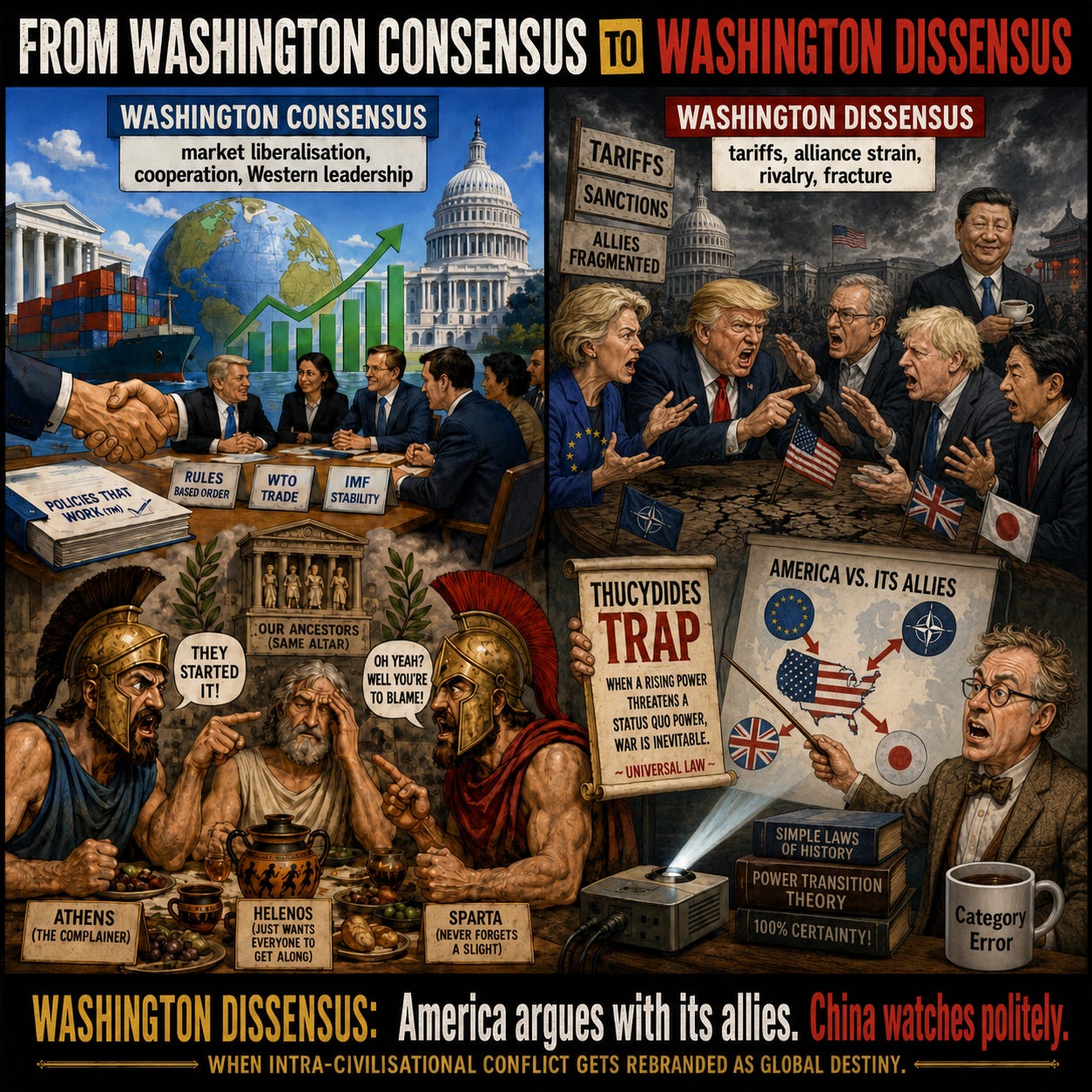
Graham Allison’s thesis in Destined for War (2017) has shaped a decade of debate on Sino-American rivalry. By invoking Thucydides’s judgement that ‘The growth of the power of Athens and the alarm which this inspired in Sparta, made war inevitable’ (Thucydides 1998, p. 16) is the very passage Allison places at the foundation of his thesis (Allison 2017). Allison distilled a structural logic of power transition: a rising power threatens an established hegemon, and the resulting stress renders violent conflict highly probable. Yet this framing rests on a foundational category error that is not merely analytical but fundamental. Allison extracts an intra-civilisational conflict, the Peloponnesian War between Greek poleis organised through the Spartan-led Peloponnesian League and the Athenian-led Delian League, recasting it as a universal theory of international great-power transition. In doing so, he takes a domestic civil dispute between Athenian and Spartan Greeks, bound by shared language, gods, mythic inheritance, aristocratic codes, games, sanctuaries and a common memory of resistance to Persia, and turns it into an international theory of superpower dominance.
Thucydides himself exposed the deepest trap elsewhere. In 427 BCE the island polis of Corcyra descended into one of the most savage episodes of civil strife (stasis) recorded in classical antiquity. What began as a factional struggle between a democratic party aligned with Athens and an oligarchic party backed by Corinth quickly spiralled into wholesale slaughter. Families were torn apart, kinship yielded to party loyalty, and even neutral citizens were murdered for the crime of refusing to take sides. Thucydides presents this not merely as a local tragedy but as the paradigmatic case of how civil war unleashes internal collapse. In the analytical chapters that follow his narrative, he offers what remains one of the most penetrating diagnoses of political disintegration in Western literature.(Thucydides, 1998, 3.82–83).
The deeper horror, for Thucydides, lay not in the violence itself but in the moral and linguistic inversion it produced. Millenia before Orwell’s critique of political language and linguistic manipulation (Orwell, 1946; 1949), Thucydides recognised how civil strife could corrupt the meaning of words themselves. To fit with the change of events, words, too, had to change their usual meanings.
Reckless audacity became celebrated as loyal courage; prudent hesitation was denounced as cowardice; moderation was scorned as unmanly weakness; and the ability to see both sides of a question was dismissed as unfitness for action. Fanatical enthusiasm passed for true manhood, while plotting and betrayal were rebranded as legitimate self-defence. Oaths lost their binding power; trust evaporated; and private enmity disguised itself as political principle. The ‘ancient simplicity’ in which honour had once played a central role was laughed to scorn and swept away. Society fractured into armed camps in which no man trusted his fellow (Thucydides, 1972, 3.82–83; Thucydides, 1998, p. 420). War both foreign and domestic, he argues, acts as a violent teacher that strips away the restraints of civilisation, revealing the raw tendencies of human nature, or physis, when freed from the constraints of convention, or nomos. Such evils ‘have occurred and always will occur, as long as the nature of mankind remains the same’.
The Peloponnesian War was therefore never a clean model of inter-civilisational transition; it was a civil war within a civilisational field, fought by rival alliance systems struggling for authority over who would define Hellas itself. The real Thucydidean mechanism, as Thucydides himself warned in his searing account of stasis at Corcyra, was the fear that one internal model of order would displace another within the same civilisational arena.
This category error fatally weakens the analogy when applied to contemporary Sino-American rivalry. China is not Athens inside America’s Greek world. It is a civilisation-state with its own historical depth, political grammar and strategic memory (Jacques, 2012). America, by contrast, has never been a civilisation in the Chinese sense. It is a nascent federal republic that became the leading power within a wider transatlantic and Western civilisational order. Its post-1945 hegemony rested not on solitary national capacity alone, but on an extended ecology of alliances and institutions: NATO, Europe, Canada, Australia, Japan, Bretton Woods, the dollar system and the wider liberal order (Ikenberry, 2011). That ecology magnified American power and gave a burgeoning federal republic civilisational reach.
Today that ecology is fraying under Trumpian policies. The Washington Consensus, once associated with market liberalisation, institutional cooperation and Western leadership, has mutated decisively into a Washington Dissensus.
Reciprocal tariffs on European allies, hostility towards NATO burden-sharing, suspicion of Europe, antagonism towards Canada and transactional treatment of Australia and Japan have accelerated America’s withdrawal from the civilisational sphere that once amplified its primacy (White House, 2025; German Marshall Fund, 2025). Stripped of that wider ecology, the United States appears less as a self-sufficient civilisation-superpower than as a national actor retreating into defensive sovereignty. Relative to China’s civilisational cohesion, this contraction makes America weaker than Allison’s binary model allows.
The true Thucydidean analogy therefore lies inside the United States itself. The historically dominant non-Hispanic white majority, which accounted for roughly 64 per cent of the US population in 2010 and around 57–58 per cent in 2024–2025 estimates, faces the prospect of losing majority status by the middle of the twenty-first century (US Census Bureau, 2025; Brookings Institution, 2018). The rising force is not a foreign state, but a younger, more urban, mixed-race and immigrant-shaped demographic coalition. The old ruling bloc therefore experiences ordinary democratic arithmetic as civilisational displacement. Democratic institutions built when majority rule confirmed its cultural dominance now appear threatening because they may empower a different majority. Elections, courts, federalism, voting rights, education, immigration policy and even census categories have become battlegrounds over who owns the republic.
The policies associated with the Trump administration and anticipated in Project 2025 (Heritage Foundation, 2023) suggest the beginning of an internal Thucydidean crisis. President Trump and his vanguard: most prominently led by Stephen Miller, the chief architect of the administration’s immigration agenda, embarking the Administration on an aggressive campaign of mass deportation and immigration control explicitly framed as necessary to disrupt the emerging mixed-race electoral majority and rebalance demographics in favour of the non-Hispanic white population (Migration Policy Institute, 2026; New York Times, 2026). ICE arrests have quadrupled, tactical enforcement operations involving armed federal agents and National Guard units have targeted unauthorised immigrants in major cities, legal immigration has been slashed by an estimated 33–50 per cent, and the administration has pursued a million deportations per year while invoking emergency powers and dismantling longstanding norms (Forbes, 2026; American Immigration Council, 2024/2026 updates).
These measures are not presented merely as border security; they are extolled as the required forceful disruption of demographic trends that would otherwise consign the historic majority to minority status. In doing so, the declining status group deploys the full coercive apparatus of the state to resist the logic of majority rule itself. The result is the opening phase of what amounts to domestic civil strife. It has not yet manifested as open armed conflict, but appears instead in the erosion of institutional trust, the weaponisation of democratic machinery, and the explicit mobilisation of state power against perceived civilisational displacement.
Wang Huning saw this more clearly than Allison. In America Against America (1991), Wang’s central insight was not that America would be defeated from outside, but that its internal contradictions, race, individualism, inequality, commodification and institutional mistrust, could hollow it out from within. Allison saw America facing China across the Pacific. Wang saw America facing itself in the mirror.
Thucydides would have recognised Wang’s version first.
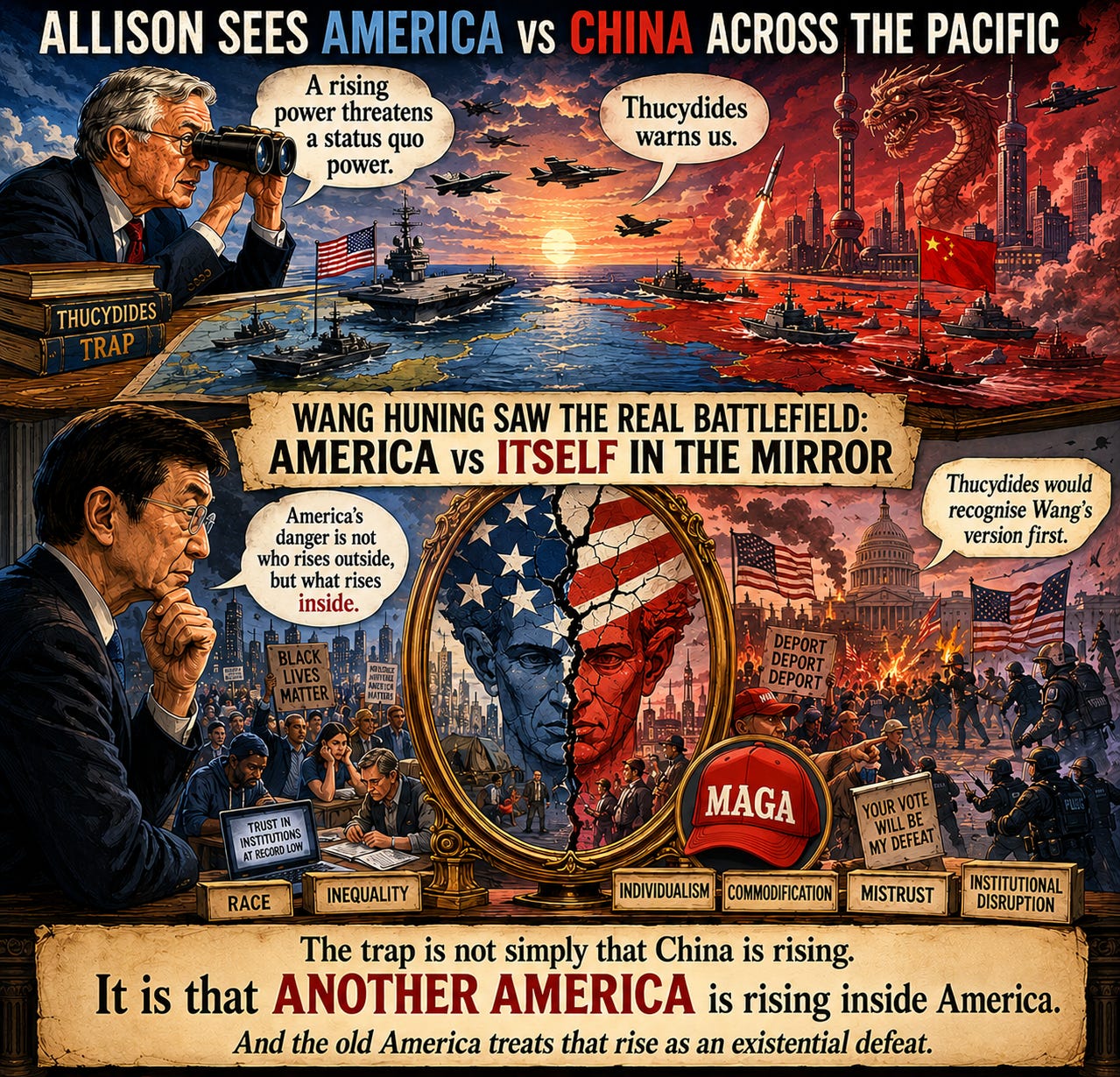
Allison’s category error is therefore not merely academic. By misapplying an intra-civilisational Greek precedent to an inter-civilisational contest, the Thucydides Trap thesis has obscured the more immediate danger: the United States may enter great-power competition already fractured along lines that a civilisation-state like China does not confront. The Peloponnesian War was a civil war within a civilisational field, fought by rival alliance systems seeking to define the Greek order. The sharper lesson for America is therefore internal. A republic whose historic majority no longer trusts democracy because democracy may empower a different majority—which responds by mobilising deportation, demographic engineering and institutional disruption—has already entered its own Thucydidean crisis. The trap is not simply that China is rising. It is that another America is rising inside America, and the old America increasingly treats that rise as an existential defeat requiring extraordinary, even violent, countermeasures.
The scholar’s duty in international relations theory is not to ratify prevailing orthodoxies but to expose their fragilities. Allison’s Thucydides Trap, read through the prism of offensive realism (Mearsheimer 2014), correctly registers the structural tension between a rising China and a ruling United States. Yet it remains silent on the deeper Thucydidean mechanism that actually undid the Hellenic world: the stasis that exhausted the independent city-state system, paved the way for Alexander’s transient empire, and helped inaugurate a long historical trajectory in which Greek political life disappeared as a sovereign force for nearly two millennia. The contemporary analogue is therefore not interstate war but endogenous collapse.
Washington’s relentless pursuit of containment—QUAD and AUKUS architectures, freedom-of-navigation operations in Chinese-claimed waters, multi-billion-dollar arms packages to frontline allies, and the projected trillion-dollar Golden Dome missile shield—diverts fiscal, institutional and moral resources from the republic’s internal ecology at the precise moment when that ecology is under maximum stress (Congressional Research Service 2025).
Wang Huning saw this more clearly than any Western realist: America’s greatest adversary is America itself (Wang 1991). Pape’s documentation of an “era of violent populism” confirms the trajectory: ordinary citizens increasingly license force to resist perceived civilisational displacement, eroding the very institutional trust that has historically underwritten American power (Pape 2025). The war that matters, therefore, may not be the one fought across the Pacific but the one already unfolding inside the United States. If the republic neglects its own internal population while expending blood, treasure and political capital on offensive-realist objectives abroad, the Thucydidean trap it faces will not be China’s rise; it will be its own stasis.
Epilogue: Returning to Thucydides
Readers may judge for themselves whether the modern concept of the ‘Thucydides Trap’ accurately reflects the concerns of Thucydides himself. The phrase does not appear anywhere in The History of the Peloponnesian War. It is a modern formulation derived principally from a single sentence in Book I: ‘The growth of the power of Athens and the alarm which this inspired in Sparta, made war inevitable’ (Thucydides 1998, p. 16) is the very passage Allison places at the foundation of his thesis (Allison 2017).
To assist readers unfamiliar with the original, the following short extract from Book III captures Thucydides’ deeper preoccupation: the civil strife (stasis) that, in his view, posed the gravest threat to the Hellenic world. In 427 BCE the island polis of Corcyra descended into factional massacre between democratic and oligarchic parties. What began as a local power struggle quickly produced wholesale domestic slaughter, as political polarisation corrupted language, reversed morality and reduced ordinary ethical restraints into the friend/enemy dichotomy.
The Landmark Thucydides: A Comprehensive Guide to the Peloponnesian War
Thucydides. (1998). The Landmark Thucydides: A Comprehensive Guide to the Peloponnesian War [Kindle iOS version]. Retrieved from Amazon.com Book Three - Page 420 ·
3.81 427 5th Year/Summer CORCYRA As the Peloponnesians flee, the Corcyraean popular faction massacres its domestic foes.
So bloody was the march of the revolution, and the impression which it made was the greater as it was one of the first to occur. Later on, one may say, the whole Hellenic world was convulsed; struggles being everywhere made by the popular leaders to bring in the Athenians, and by the oligarchs to introduce the Spartans. In peace there would have been neither the pretext nor the wish to make such an invitation; but in war, with an alliance always at the command of either faction for the hurt of their adversaries and their own corresponding advantage, opportunities for bringing in the foreigner were never wanting to the revolutionary parties.
[2] The sufferings which revolution entailed upon the cities were many and terrible, such as have occurred and always will occur as long as the nature of mankind remains the same; though in a severer or milder form, and varying in their symptoms, according to the variety of the particular cases. In peace and prosperity states and individuals have better sentiments, because they do not find themselves suddenly confronted with imperious necessities; but war takes away the easy supply of daily wants and so proves a rough master that brings most men’s characters to a level with their fortunes.
[3] Revolution thus ran its course from city to city, and the places which it arrived at last, from having heard what had been done before, carried to a still greater excess the refinement of their inventions, as manifested in the cunning of their enterprises and the atrocity of their reprisals.
[4] Words had to change their ordinary meaning and to take that which was now given them. Reckless audacity came to be considered the courage of a loyal supporter; prudent hesitation, specious cowardice; moderation was held to be a cloak for unmanliness; ability to see all sides of a question incapacity to act on any. Frantic violence became the attribute of manliness; cautious plotting a justifiable means of self-defense.
[5] The advocate of extreme measures was always trustworthy; his opponent a man to be suspected. To succeed in a plot was to have a shrewd head, to divine a plot a still shrewder; but to try to provide against having to do either was to break up your party and to be afraid of your adversaries. In short, to forestall an intending criminal, or to suggest the idea of a crime where it was lacking was equally commended,
[6] until even blood became a weaker tie than party, from the superior readiness of those united by the latter to dare everything without reserve; for such associations sought not the blessings derivable from established institutions but were formed by ambition to overthrow them; and the confidence of their members in each other rested less on any religious sanction than upon complicity in crime.
[7] The fair proposals of an adversary were met with jealous precautions by the stronger of the two, and not with a generous confidence. Revenge also was held of more account than self-preservation. Oaths of reconciliation, being only offered on either side to meet an immediate difficulty, only held good so long as no other weapon was at hand; but when opportunity arose, he who first ventured to seize it and to take his enemy off his guard, thought this perfidious vengeance sweeter than an open one since, considerations of safety apart, success by treachery won him the prize for superior intelligence. Indeed it is generally the case that men are readier to call rogues clever than simpletons honest, and are as ashamed of being the second as they are proud of being the first.
[8] The cause of all these evils was the lust for power arising from greed and ambition; and from these passions proceeded the violence of parties once engaged in contention. The leaders in the cities made the fairest professions: on the one side with the cry of political equality of The People, on the other of a moderate aristocracy; but they sought prizes for themselves in those public interests which they pretended to cherish and, stopping at nothing in their struggles for ascendancy, engaged in direct excesses. In their acts of vengeance they went to even greater lengths, not limiting them to what justice or the good of the state demanded, but making the party caprice of the moment their only standard, and invoking with equal readiness the condemnation of an unjust verdict or the authority of the strong arm to glut the animosities of the hour. Thus religion was in honor with neither party; but the use of fair phrases to arrive at guilty ends was in high reputation. Meanwhile the moderate part of the citizens perished between the two, either for not joining in the quarrel, or because envy would not suffer them to escape.
3.82 427 5th Year/Summer CORCYRA Thucydides describes the evils of revolution. (civil war
Thus every form of iniquity took root in the Hellenic countries by reason of the troubles. The ancient simplicity into which honor so largely entered was laughed down and disappeared; and society became divided into camps in which no man trusted his fellow. [2] To put an end to this, there was neither promise to be depended upon, nor oath that could command respect; but all parties dwelling rather in their calculation upon the hopelessness of a permanent state of things, were more intent upon self-defense than capable of confidence. [3] In this contest the blunter wits were most successful. Apprehensive of their own deficiencies and of the cleverness of their antagonists, they feared to be worsted in debate and to be surprised by the combinations of their more versatile opponents, and so at once boldly had recourse to action: while their adversaries, arrogantly thinking that they should know in time, and that it was unnecessary to secure by action what policy could provide, often fell victims to their lack of precaution.
3.83 427 5th Year/Summer CORCYRA Thucydides’ description of the evils of revolution is continued.
Meanwhile Corcyra gave the first example of most of the crimes alluded to; of the reprisals exacted by the governed who had never experienced equitable treatment or indeed anything but insolence from their rulers—when their hour came; of the iniquitous resolves of those who desired to get rid of their accustomed poverty and ardently coveted their neighbors’ goods; and lastly, of the savage and pitiless excesses into which men who had begun the struggle not in a class but in a party spirit, were hurried by their ungovernable passions. [2] In the confusion into which life was now thrown in the cities, human nature, always rebelling against the law and now its master, gladly showed itself ungoverned in passion, above respect for justice, and the enemy of all superiority; since revenge would not have been set above religion, and gain above justice, had it not been for the fatal power of envy. [3] Indeed men too often take upon themselves in the prosecution of their revenge to set the example of doing away with those general laws to which all alike can look for salvation in adversity, instead of allowing them to subsist against the day of danger when their aid may be required.
3.84 427 5th Year/Summer CORCYRA Thucydides’ description of the evils of revolution is concluded.
While the revolutionary passions thus for the first time displayed themselves in the factions of Corcyra, Eurymedon and the Athenian fleet sailed away; [2] after which some five hundred Corcyraean exiles who had succeeded in escaping took some forts on the mainland and, becoming masters of the Corcyraean territory on the mainland, made this their base to plunder their countrymen in the island, and did so much damage as to cause a severe famine in the city. [3] They also sent envoys to Sparta and Corinth to negotiate their restoration; but meeting with no success, afterwards got together boats and mercenaries and crossed over to the island, being about six hundred in all; and burning their boats so as to have no hope except in becoming masters of the country, went up to Mount Istone3a and fortifying themselves there, began to harm those in the city and obtain command of the country.
Bibliography
Allison, G. (2017) Destined for war: can America and China escape Thucydides’s trap? London: Scribe.
American Immigration Council (2024) What Project 2025 says about immigration. Available at: https://www.americanimmigrationcouncil.org (Accessed: 28 May 2026).
Brookings Institution (2018) ‘The US will become “minority white” in 2045, Census projects’, 14 March. Available at: https://www.brookings.edu (Accessed: 28 May 2026).
Congressional Research Service (2025) Defense primer: the Golden Dome for America. Washington, DC: CRS.
Forbes (2026) ‘Trump and Miller slashing legal immigration by 33% to 50%’, 20 January.
German Marshall Fund of the United States (2025) ‘What to watch in fall 2025’, 27 August.
Heritage Foundation (2023) Mandate for Leadership: The Conservative Promise. Washington, DC: The Heritage Foundation.
Ikenberry, G.J. (2011) Liberal leviathan: the origins, crisis, and transformation of the American world order. Princeton, NJ: Princeton University Press.
Jacques, M. (2012) When China rules the world: the end of the Western world and the birth of a new global order. 2nd edn. London: Penguin.
Mearsheimer, J.J. (2014) The tragedy of great power politics. Updated edn. New York: W.W. Norton.
Migration Policy Institute (2026) ‘Unleashing power in new ways: immigration under Trump 2.0 – first year’, 13 January.
New York Times (2026) ‘Stephen Miller is still pursuing his immigration agenda, but more quietly’, 5 April.
Orwell, G. (1946) ‘Politics and the English Language’, Horizon, 13(76), pp. 252–265.
Orwell, G. (1949) Nineteen Eighty-Four. London: Secker & Warburg.Pape, R.A. (2025) ‘America’s new age of political violence’, Foreign Affairs, 9 October.
Pape, R.A. (2025) ‘America’s new age of political violence’, Foreign Affairs, 9 October. Available at: https://www.foreignaffairs.com/united-states/americas-new-age-political-violence
Thucydides (1972) History of the Peloponnesian War. Translated by R. Warner. Harmondsworth: Penguin Classics.
Thucydides (1998) The Landmark Thucydides: A Comprehensive Guide to the Peloponnesian War. Edited by R.B. Strassler. New York: Free Press. p. 420
US Census Bureau (2025) Population estimates and projections. Washington, DC: US Department of Commerce.
Wang, H. (1991) America against America. Shanghai: Shanghai Literature and Art Publishing House.
White House (2025) ‘Regulating imports with a reciprocal tariff to rectify trade practices that contribute to large and persistent annual United States goods trade deficits’, 2 April.
Williamson, J. (1990) ‘What Washington means by policy reform’, in Williamson, J. (ed.) Latin American adjustment: how much has happened? Washington, DC: Institute for International Economics, pp. 7–20.
Woodruff, P. (2021) Essential Thucydides: On Justice, Power, and Human Nature: Selections from The History of the Peloponnesian War by Thucydides, https://a.co/02vX2mSW
Alcibiades: We are losing the war. Let's go attack Syracuse. What could possibly go wrong?
Trump: We are losing the war. Let's go attack Cuba. What could possibly go wrong?
This is a very interesting reading of Thucydides and especially the modern concept of the “trap”. I particularly like the focus on stasis, internal fragmentation, and the corruption of political language, a dimension often lost in the usual “rising power versus ruling power” debate.
My own view is a bit more cautious. I would not say that this replaces the power-transition argument, but it does deepen it. Thucydides was warning not only about external rivalry, but also about what happens when fear, faction, and mistrust weaken a political community from within.
In this regard, the real lesson is not that war is inevitable, but that strategic competition can become more dangerous when a society is already divided.
Well done!