International Coexistence Studies:
A Paradigm Shift in IR Theory and Pedagogy

By Alan Koch September 4, 2025
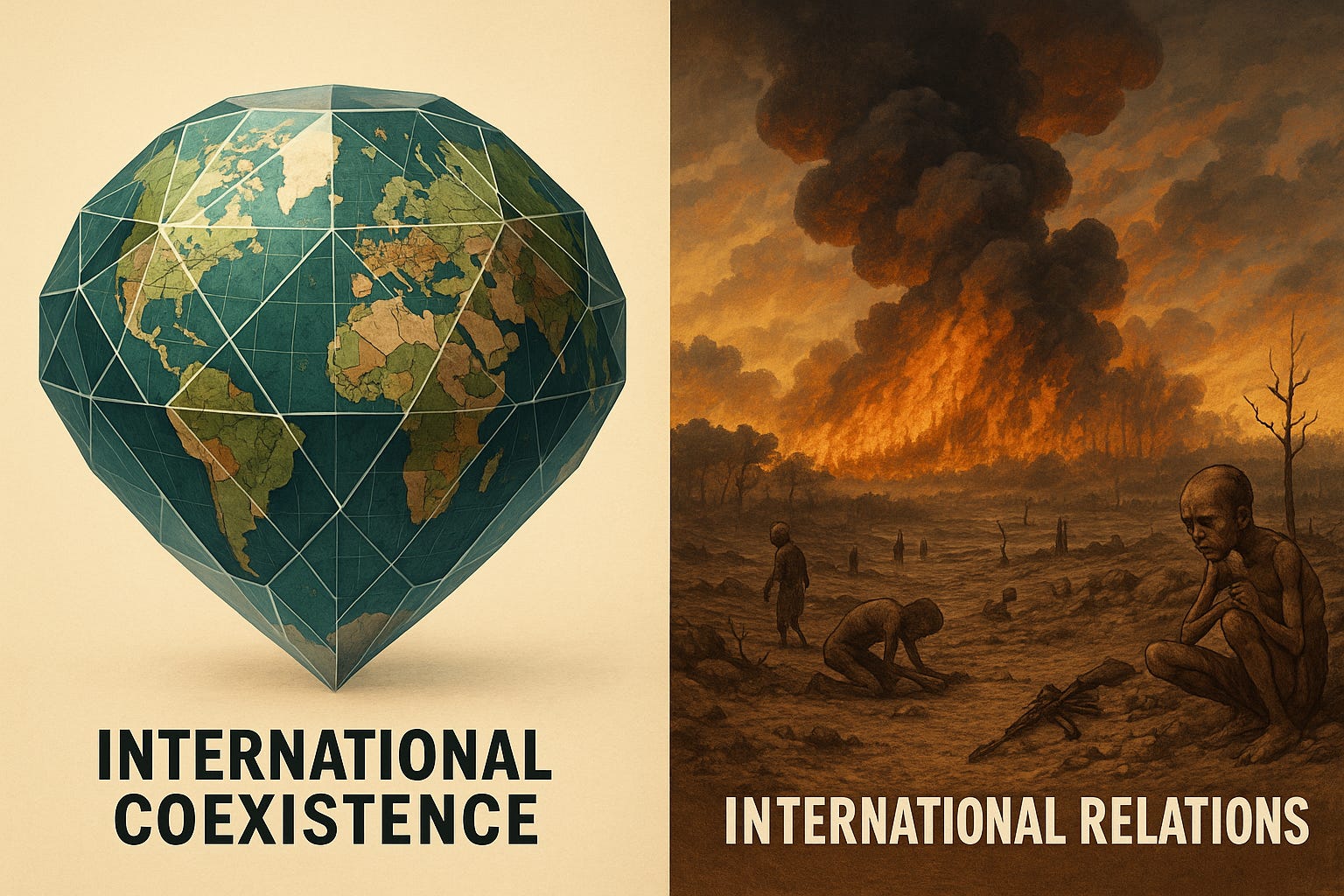
Chapter 1: Introduction
International Relations (IR) has long provided the intellectual foundation for understanding global politics, originating in the interwar period and solidifying as a discipline after World War II. It offered policymakers theoretical tools for navigating an international system of sovereign states operating in anarchy, mediated by power, institutions, and ideas (Bull 1977; Waltz 1979). Realist theories emphasized balance of power, liberalism highlighted institutional cooperation, and constructivism focused on norms and identities. However, in the third decade of the 21st century, IR’s core assumptions appear increasingly inadequate, challenged by disruptive phenomena that elude traditional explanatory and predictive capacities.
The root of this crisis lies in IR’s anarchic ontology—the assumption that the absence of a central global authority makes the international system inherently chaotic, with states as the primary rational actors seeking security or advantage. This assumption, shared across realism, liberalism, and constructivism, has dominated academic curricula and policy training, marginalizing alternative conceptions of order even as real-world developments expose its shortcomings (Hobson 2012). The recent administrations of Donald Trump illustrate these deficiencies vividly. During Trump’s first term in office (2017–2021), the United States abruptly withdrew from the Paris Climate Agreement and the Joint Comprehensive Plan of Action (JCPOA) on Iran’s nuclear program, and deliberately paralyzed the World Trade Organization (WTO) appellate body while launching a trade war with China. These moves directly undermined liberal assertions that institutions can endure and manage anarchy even as hegemonic power wanes (Keohane 1984; Ikenberry 2011). The actions disrupted established norms of cooperation and highlighted the fragility of institutions long presumed to mitigate anarchic pressures.
The contradictions only intensified in Trump’s second term (2025–present, following his 2024 re-election). By mid-2025, U.S. tariff policy had evolved into an instrument of selective punishment, targeting allies more severely than adversaries. India – a key partner in the “Quad” alliance countering Chinese influence in the Indo-Pacific – faced a punitive 50% tariff hike, ostensibly for maintaining economic ties with Russia (Chaudhuri 2025). Switzerland, a neutral but Western-aligned economy, was stunned by a 39% tariff on its exports, whereas China – ostensibly America’s primary strategic rival – received a comparatively moderate 30% tariff as part of a negotiated truce (Tooze 2025). Compounding this, Trump introduced a 15% “tribute tax” on U.S. chipmakers Nvidia and AMD for their sales to China, effectively repurposing private corporations as instruments of geopolitical leverage (BBC 2025a; Hufbauer and Schott 2025). Such developments confound conventional IR paradigms. Offensive realism, as articulated by John Mearsheimer, predicts an inevitable U.S.–China confrontation driven by structural power imperatives (Mearsheimer 2001). Yet Trump’s pragmatic accommodation with Beijing, juxtaposed against punitive measures toward allies, defies any realist logic of consistent great-power rivalry. Liberal institutionalism posits that bodies like the WTO, International Monetary Fund (IMF), or Group of Seven (G7) facilitate cooperation and restrain conflict, but these institutions appeared impotent in the face of unilateral executive actions bypassing multilateral norms (Narlikar 2010; Hillman 2018). Constructivism, which contends that anarchy’s effects are socially constructed (“anarchy is what states make of it” (Wendt 1992)), struggles to explain the rapid erosion of cooperative norms under Trump’s transactional approach, where alliances were recalibrated based on immediate economic concessions rather than shared values (Acharya 2023).
Susan Strange’s concept of structural power offers a more robust analytical framework for such phenomena. Strange identifies production, finance, knowledge, and security as structural domains where non-state actors – corporations, banks, technology platforms, and epistemic networks – exert decisive influence independent of state control (Strange 1988; 1996; Guzzini 2019). This perspective foreshadowed the 2025 landscape: platform companies like Amazon Web Services (cloud infrastructure), Palantir (data analytics), Tencent (digital ecosystems), OpenAI (artificial intelligence), Google and Baidu (knowledge and AI) have accrued authority over critical global systems. The 2025 “AI chip tribute” exemplifies this dynamic: by extracting rent from semiconductor supply chains, the U.S. government transformed private tech firms into de facto tributaries, reshaping U.S.–China relations through structural dependency rather than direct military confrontation (Tooze 2025). Complementing Strange’s insights, Adam Tooze’s historical analysis of the 2008 global financial crisis underlines the primacy of financial structures in global order (Tooze 2018). Tooze showed how the U.S. Federal Reserve’s extension of liquidity swap lines to central banks in Europe, Asia, and beyond averted a systemic collapse, revealing structural forces operating beneath the state-centric surface of IR (Tooze 2019). These insights resonate with the dynamics of 2025: Trump’s tariff escalations and tech tributes are buttressed by dollar hegemony and global financial interdependence, rendering IR’s traditional state-centric focus obsolete or at least insufficient (Tooze 2019; Guzzini 2019).
In response to IR’s crisis of relevance, this dissertation proposes International Coexistence Studies (ICS) as a meta-theoretical framework. ICS advances a crystalline ontology of world politics, envisioning global order as a lattice of structured coexistence rather than as an inherently entropic (disorderly) arena. In this view, coexistence is not a fragile interlude between conflicts but a resilient baseline condition, patterned and reinforced through interactions among states, civilizations, and structural actors alike. ICS draws on long-standing civilizational concepts that have prioritized order and harmony over anarchy: for example, the Chinese idea of Tianxia envisions a harmonious all-under-heaven that transcends Westphalian sovereignty (Qin 2007); India’s Panchsheel principles emphasize mutual respect and non-interference (Jaishankar 2020); Africa’s Ubuntu philosophy stresses communal interdependence (Kotzé 2016); and the “ASEAN way” favors consensus-building over adversarial politics (Acharya and Buzan 2019). By integrating these non-Western traditions with Strange’s structural-power perspective, ICS reframes conventional IR theories as useful but narrow special cases. State-centric paradigms like realism, liberalism, and constructivism retain utility for analyzing specific phenomena—power rivalries, institutional bargaining, norm diffusion—but within ICS they are subsumed as part of a broader canvas that also accommodates platform sovereignty and civilizational pluralism.
The stakes of this paradigmatic shift are high. Universities and think tanks that persist with IR’s anarchy-centric worldview risk equipping future decision-makers with tools ill-suited for a world where actors like Nvidia or the Federal Reserve can dictate outcomes more decisively than traditional statecraft. By contrast, ICS offers the conceptual apparatus to foster resilient coexistence in a multipolar order increasingly dominated by technological and financial platforms. For instance, the seemingly erratic tariff asymmetries of 2025 become intelligible through an ICS lens as a recalibration of a structured lattice: punishing allies for perceived misalignment (e.g. India’s ties with Russia) while extracting structural rents from rivals (China’s tech payments), echoing historical systems of asymmetrical exchange rather than purely anarchic power plays (Chaudhuri 2025; Hufbauer and Schott 2025). In short, ICS helps explain how order can persist and even be purposefully restructured amid such turbulent changes.
To substantiate this argument, the dissertation is organized as follows. Chapter 2 provides a comprehensive literature review, critiquing the limitations of mainstream IR paradigms and highlighting alternative insights from Strange, Tooze, and non-Western thinkers that point toward a new framework. Chapter 3 elaborates the ontological shift from entropy to crystallinity in world politics, using historical precedents and a conceptual comparison to contrast the IR view of inherent anarchy with the ICS view of structured coexistence. Chapter 4 uses the case of Donald Trump’s administrations as an empirical study, illustrating IR’s explanatory failures and demonstrating how ICS better interprets these novel patterns. Chapter 5 examines the roles of structural power players in the current global order – spanning production, finance, knowledge, and security domains – to show how platform sovereignty and other structural forces transcend the state-centric model. Chapter 6 then outlines the ICS framework in detail, including its ontological foundations, epistemological stance, and teleological (goal-oriented) assumptions, and discusses policy implications of adopting this meta-theory. Chapter 7 addresses potential counterarguments from realist, liberal, constructivist, and critical perspectives, offering rebuttals to each and clarifying how ICS differentiates itself. Chapter 8 concludes by discussing the broader implications of ICS for policy and academia, including how this approach could reshape strategy and educational curricula to better navigate a world of complex interdependence.
In an era when companies like Nvidia or Google can influence geopolitics as much as states, IR’s traditional state-centrism has become antiquated (Tooze 2019; Guzzini 2019). ICS charts a forward path by merging civilizational insights with structural realities to promote sustainable coexistence. The urgency of this paradigm shift is underscored by the evolving realities of 2025. Trump’s trade policies, for example, have introduced a baseline 10% tariff on all imports (with higher rates for selected countries), rapidly redrawing global trade architectures and revealing the need for analytical frameworks that transcend state-centric assumptions (Hufbauer and Schott 2025). Meanwhile, platform enterprises controlling data flows and artificial intelligence infrastructure have emerged as quasi-sovereign actors, blurring the line between public and private power and demanding analytical tools beyond the scope of traditional IR (Tooze 2025). By integrating structural power with principles of civilizational coexistence, ICS not only explains such phenomena but also points toward pathways for a more stable global order amid fragmentation.
This approach aligns with calls for a more inclusive “Global IR” that embraces diverse perspectives and epistemologies (Acharya 2014). Positioning ICS as an overarching framework invites scholars to rethink disciplinary boundaries—treating realism, liberalism, constructivism, and others as specialized tools within a more comprehensive toolbox. For policymakers at venues like Chatham House or the Council on Foreign Relations, an ICS perspective offers concrete insights: for instance, recognizing the influence of structural power can inform strategies for regulating AI platforms, ensuring financial stability, or facilitating dialogue among civilizations, thereby mitigating risks in a fractured world. Historical evidence supports the plausibility of a coexistence-centric order. The 2008 financial crisis, as chronicled by Tooze (2018), presaged a structural turn where central banks acted as global stabilizers beyond traditional diplomacy. Likewise, the “tech tribute” of 2025 highlights how knowledge and production structures (e.g. semiconductor networks) have become battlegrounds for influence, with platforms like OpenAI shaping what is considered knowledge or truth (Strange 1996). ICS’s crystalline ontology is equipped to accommodate these shifts, viewing global order as an organic lattice capable of absorbing shocks like tariff wars without descending into chaos.
Notably, coexistence has often been the historical norm rather than anarchy. The Ottoman Empire’s millet system, for example, maintained religious pluralism for centuries within a single imperial framework (Barkey 2008). The Pax Mongolica in the 13th–14th centuries facilitated cosmopolitan trade and cultural exchange across Eurasia (Rossabi 2012). These and other precedents – many rooted in non-Western traditions – bolster the ICS claim that anarchy is not an inevitable condition of international life but rather a contingent construction that can be deconstructed and replaced by more orderly arrangements using structural and civilizational lenses.
In sum, the tumultuous Trump era marks a pivotal juncture for the study and practice of international relations. By advancing International Coexistence Studies as a meta-theoretical alternative, this dissertation aims to catalyze a renewal in our understanding of global politics. It seeks to equip scholars and practitioners with a framework suited to the complexities of structural power and platform sovereignty, ultimately in the service of fostering a resilient global coexistence.
Chapter 2: Literature Review
Mainstream IR Paradigms and Their Shortcomings. Realism, the foundational paradigm of IR, traces its lineage to ancient thinkers like Thucydides but was formalized in the mid-20th century. Hans Morgenthau’s classical realism focused on human nature and power politics (Morgenthau 1948), which evolved into Kenneth Waltz’s neorealism that placed anarchy at the core of the international system’s structure (Waltz 1979). John Mearsheimer’s offensive realism further predicted relentless great-power competition, exemplified by an anticipated U.S.–China rivalry for dominance (Mearsheimer 2001). The unfolding of Trump’s second-term policies, however, highlights realism’s blind spots. The fact that the Trump administration proposed harsher tariff penalties on allies like India than on strategic competitor China runs counter to realist expectations and cannot be easily explained by a simple balance-of-power logic (Stokes 2018; Cohen 2019). Structural forces – such as the influence of powerful multinational firms like Nvidia – seem to steer state behavior in ways realism doesn’t account for, indicating that states are not always unitary rational actors maximizing power in a straightforward manner.
Liberal institutionalism offers a different lens, arguing that cooperation is possible under anarchy through regimes and institutions. Robert Keohane famously contended that international regimes (rules and institutions) can endure even after the decline of the hegemonic power that created them, by providing information and reducing transaction costs (Keohane 1984). G. John Ikenberry likewise defended the resilience of the U.S.-led liberal order, claiming its norms and institutions would bind states even as power shifts (Ikenberry 2011). Recent events have tested these claims: the stagnation of the WTO since 2019 and Trump’s willingness to bypass forums like the G7 (for example, imposing tariffs without consultation or withdrawing from agreements) expose how vulnerable institutions are to the whims of powerful executives (Narlikar 2010; Hillman 2018). The Trump administration’s behavior – such as deliberately crippling the WTO dispute resolution mechanism and enacting sweeping tariffs via executive authority – suggests that liberal institutions can be paralyzed or ignored when major states choose to act unilaterally (Hufbauer and Schott 2025). This challenges the liberal faith that institutions inherently moderate anarchy.
Constructivism holds that anarchy is “what states make of it” – its effects are mediated by social norms, identities, and shared understandings (Wendt 1992). Alexander Wendt and others argued that state behavior is shaped by these intersubjective factors; even though the system is formally anarchic, it need not be Hobbesian if states develop cooperative norms or collective identities (Wendt 1999). However, mainstream constructivism often maintained state-centrism and has been critiqued for Eurocentric biases that assume Western historical experiences are universal (Hobson 2012). In practice, recent years have shown the limits of norm-driven change: the normative agenda of the Biden administration, framing world politics as “democracy vs. autocracy,” gained little traction in the Global South and was quickly overturned by Trump’s return to explicitly transactional politics (Acharya 2023). Norm diffusion proved fragile when major powers did not buy into those norms. The rapid crumbling of multilateral cooperation norms under the pressure of nationalistic or transactional policies underscores that constructivism, while insightful about the role of ideas, may underplay material and structural constraints.
Beyond the State-Centric Orthodoxy – Structural Power and Global Pluralism. Susan Strange offered a powerful critique of IR’s state-centric orthodoxy by highlighting the concept of structural power – the power to shape frameworks within which others operate (Strange 1988; 1996). She identified four key structures: production, finance, knowledge, and security. In Strange’s view, these structures often give non-state entities significant influence. For example, multinational corporations in production or global banks in finance can set terms that states must adapt to. By the late 20th century, Strange observed that markets and corporations at times constrained or directed state actions (Strange 1998). This perspective was prescient: by 2019–2025, we see that non-state actors dominate crucial sectors (Guzzini 2019; Cohen 2019). The rise of platform companies – from tech giants to financial institutions – means that outcomes in areas like digital communications, artificial intelligence, or capital flows are determined as much by corporate policies and market forces as by inter-state negotiations. Indeed, Strange’s insights anticipated scenarios like the 2025 “tribute tax” on tech companies’ China business, which effectively places firms in the role of geopolitical agents (Tooze 2018; Guzzini 2019).
Adam Tooze’s historical work complements Strange by providing empirical evidence of structural power in action. In his analysis of the 2008 financial crisis and its aftermath, Tooze demonstrated that global finance – especially the U.S. Federal Reserve and other central banks – became the true safety net of the international system, taking actions that were not coordinated by any formal international institution but were crucial to global stability (Tooze 2018). He later argued that the lessons of 2008 show how state-centric IR theories missed the centrality of financial structures and transnational networks that can override traditional state boundaries (Tooze 2019). The ongoing economic and financial upheavals (including those triggered by the tariff wars of 2025) reaffirm how pivotal structural forces are. For instance, U.S. tariffs and China’s responses are playing out under the shadow of U.S. dollar dominance and global supply chain dependencies – factors that conventional IR treats as background, but which structural analyses put at the forefront.
Non-Western intellectual traditions also provide important building blocks for ICS by challenging IR’s entrenched assumption of entropy and offering coexistence-centric alternatives. Chinese scholar Yan Xuetong’s writings on hierarchical order or Qin Yaqing’s discussion of Tianxia illustrate an ontology where harmony and hierarchy can maintain international order without a single sovereign authority (Qin 2007). India’s diplomatic philosophy of Panchsheel advocates mutual respect for sovereignty and non-aggression as guiding principles, reflecting a civilizational ethos of coexistence (Jaishankar 2020). In African thought, the concept of Ubuntu (“I am because we are”) emphasizes communal relations and has influenced ideas of conflict resolution and diplomacy that prioritize reconciliation and inclusion over zero-sum confrontation (Kotzé 2016). The Southeast Asian “ASEAN Way” privileges consensus and flexible, informal dialogue, avoiding legalistic or adversarial approaches (Acharya and Buzan 2019). These perspectives all challenge the notion that international politics is inevitably a war of all against all; instead, they suggest that pluralistic order and cooperative norms can be deeply rooted in cultural and historical practices outside the West. Such traditions directly contest IR’s traditional ontology of anarchy by offering what this dissertation terms crystalline options – patterns of order that are structured and enduring even without a singular sovereign. This is especially pertinent when we consider contemporary events like Trump’s sanctions on allies for not aligning with U.S. preferences (for example, India’s oil trade with Russia leading to U.S. tariffs) – scenarios where Western-centric IR predictions falter, but alternative frameworks might better explain the real dynamics (Acharya 2014; Al Jazeera 2025).
Synthesis – Toward a New Framework. The literature thus reveals that mainstream IR theories have significant blind spots in the face of structural transformations. Realism’s enduring appeal lies in its parsimonious focus on power, but its assumption of unitary, security-seeking states breaks down under conditions where global supply chains or digital platforms constrain state behavior (Mearsheimer 2001; Cohen 2019). Liberalism’s optimism about institutions fails to account for how easily those institutions can be side-lined by powerful states or by new forms of economic nationalism (Keohane 1984; Hillman 2018). Constructivism’s emphasis on shared norms does not adequately grapple with the brute realities of material interdependence and inequality (Wendt 1992; Hobson 2012). In contrast, Strange’s model of multidimensional structural power begins to address these gaps by decentering states and highlighting other sources of influence (Strange 1988; Guzzini 2019). Tooze’s narrative of financial crisis management extends this understanding, showing that in extreme situations it is the structural arrangements (like central bank networks) that govern outcomes, not the formal interstate agreements (Tooze 2018; Tooze 2019). Meanwhile, non-Western approaches contribute ontological diversity, demonstrating that our concepts of order vs. disorder in world politics should not be confined to the Westphalian, Eurocentric experience (Acharya and Buzan 2019). They empower a more pluralistic, coexistence-oriented view that International Coexistence Studies seeks to build upon.
In summary, the existing literature highlights both the shortcomings of traditional IR paradigms and the pieces necessary for an alternative framework. These insights set the stage for ICS, which intends to integrate structural power analysis and civilizational pluralism into a new meta-theory capable of overcoming IR’s current limitations.
Chapter 3: Ontological Shift – From Entropy to Crystallinity
IR’s prevailing ontology assumes anarchy as the baseline condition of the international system. In this orthodox view, the absence of a world government leads to an environment of entropy – i.e. inherent disorder where order, when it exists, is always tenuous and must be constantly enforced or negotiated. Classic statements by Waltz, Keohane, and others reinforce this image of a self-help system: Waltz (1979) famously argued that because the system is anarchic, states can rely only on themselves for security; Keohane (1984) acknowledged anarchy but sought ways to mitigate its effects through institutions; Wendt (1992) accepted anarchy but contended its implications are socially constructed. Nonetheless, even constructivists accepted the structural fact of anarchy as the starting point. This entropic ontology tends to obscure instances of resilient order and coexistence that persist without a central enforcer. For example, the punitive tariffs that Trump aimed at U.S. allies in 2025 – counterintuitive from a balance-of-power perspective – reveal patterns of behavior (punishment and reward in trade relations) that do not fit neatly into a story of anarchic chaos or stable hierarchy. They suggest a reconfiguration of order that IR’s binary of anarchy vs. hierarchy struggles to describe (Hufbauer and Schott 2025).
By contrast, International Coexistence Studies (ICS) advances an ontology of crystallinity. In the crystalline view, global politics forms a lattice of structured interactions that, like a crystal, has an underlying order and stability even if it is composed of diverse elements. Coexistence is the default state of this system rather than a fragile exception. Order is generated through interdependence and patterns of relations, not imposed only by hegemonic power or momentary norms. History provides evidence for the idea of structured coexistence. The Ottoman Empire’s millet system, for instance, allowed multiple religious communities to coexist under a broad imperial order for centuries, each community having autonomy in certain matters (Barkey 2008). The Pax Mongolica in the 13th century created a transcontinental zone of trade and communication under Mongol rule, where diverse peoples interacted relatively peacefully and commerce thrived (Rossabi 2012). The Roman Empire, especially through the extension of Roman citizenship to conquered peoples, established a kind of pluralistic order where different cultures coexisted under a common political framework (Goldsworthy 2016). These examples show long-lasting orders that were not simply anarchic free-for-alls; rather, they were characterized by layered authority and negotiated coexistence.
To clarify the contrast between the conventional IR ontology and the ICS ontology, consider Table 1 below, which compares key dimensions of the two:
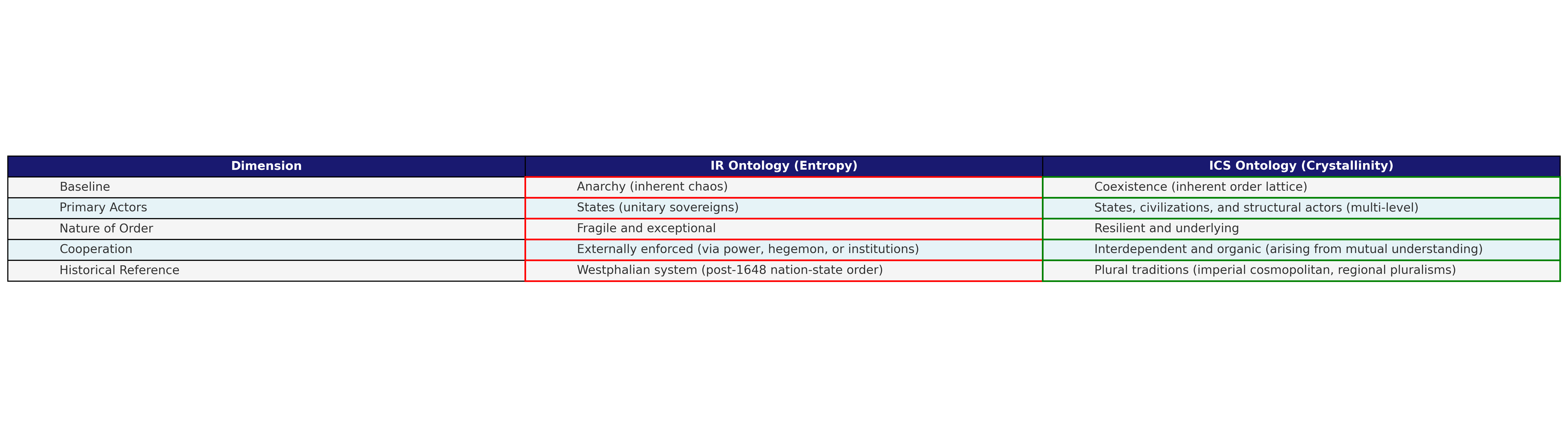
Under the entropic view of IR, conflict and competition are expected norms; cooperation is hard-won and always at risk. The crystalline view of ICS, however, sees patterned coexistence as the norm – even if conflict occurs, it happens within a larger context of ongoing relationships and structures that persist.
Notably, Susan Strange’s structural categories align well with the idea of crystallinity. Her four structures (production, finance, knowledge, security) can be thought of as the scaffolding of the lattice that ICS envisions (Strange 1988; 1996; Guzzini 2019). For example, Trump’s proposed AI chip tax can be interpreted not as a random act of economic aggression but as a deliberate insertion into the lattice of the tech supply chain – a way of extracting rent within an interdependent structure rather than overthrowing the game board entirely. In other words, rather than engaging in direct confrontation with China, the U.S. is reconfiguring a node in the global production network to its advantage, consistent with a lattice-like strategy (Tooze 2018). ICS would describe this as a shift in one part of the crystal lattice (the tech sector), altering some connections (making U.S. tech firms tributary to government policy) while maintaining overall coexistence (U.S. and China avoid an all-out breakdown in trade).
Adopting a crystalline ontology also directly challenges IR’s Eurocentrism. The conventional narrative of international order is heavily based on European history – the Westphalian model of sovereign states, the balance of power in Europe, and later the liberal international order under U.S. hegemony. By weaving in ideas like Tianxia or Panchsheel, ICS decodes contemporary events through non-Western lenses (Qin 2007; Jaishankar 2020; Acharya 2014). Trump’s highly transactional deal-making, for example, can be seen as forming ad hoc hierarchies and tribute-like arrangements reminiscent of older tributary systems, rather than as inexplicable deviations from rational state behavior. A Tianxia perspective might interpret China’s willingness to strike a temporary truce under tariff pressure not as defeat but as a move to restore harmony in the relationship – a lattice adjustment that preserves face and balance, rather than an anarchic capitulation (Qin 2007). By recognizing such alternative interpretations, ICS equips policymakers and analysts to be more resilient and creative. For instance, an ICS-informed analysis might suggest that in dealing with tariff conflicts, finding a relational equilibrium (such as offering concessions in one domain to offset pressures in another) could achieve coexistence better than insisting on across-the-board retaliation.
The entropic worldview of mainstream IR tends to reinforce conflict expectations – if you assume the world is basically a hostile, chaotic place, policies will mirror that, potentially creating self-fulfilling prophecies of confrontation. It can also lead to overlooking historical periods of peaceful coexistence or symbiosis (Barkey 2008). The crystalline worldview acknowledges those patterns of resilience and tries to learn from them. It integrates the role of structural power into our understanding of order: for example, how tech platforms or financial systems today provide a kind of hidden stability or interdependence in international affairs (Strange 1996; Cohen 2019). In Trump’s case, ICS’s ontology clarifies why his “tribute tax” on AI chips, while confrontational in tone, might actually stabilize the U.S.–China relationship by creating a structured channel of exchange (albeit asymmetrical) rather than letting tensions spiral out into a broader conflict (Hufbauer and Schott 2025). The existence of that structured economic link (even one that looks like extortion) can be interpreted as part of a coexistence lattice that prevents total breakdown.
The implications of shifting from entropy to crystallinity are transformative for both IR theory and policy practice. If IR scholars embrace a crystalline ontology, they would move away from framing every rising power or power transition as a prelude to war (a notion common in outlets like Foreign Affairs that often predict inevitable U.S.–China conflict). Instead, they would investigate sources of stability and patterns of interdependence that could be strengthened to maintain order (Acharya 2023). Likewise, policy think-tanks that currently fixate on worst-case conflict scenarios might reorient towards strategies of resilience and polycentric governance. For example, rather than viewing the U.S.–China trade confrontation purely in zero-sum terms, an ICS approach for policymakers (such as those at Chatham House) would explore how multiple stakeholders—states, corporations, international bodies—can be engaged to foster a balanced outcome where each side’s core needs are met (Tooze 2025). The notion of polycentric governance (multiple overlapping centers of authority) fits naturally with ICS: it suggests that to manage a world of lattice-like order, we should empower networks of cities, corporations, regional blocs, and civil society, not rely solely on state-to-state negotiations.
Adopting a crystalline perspective also helps decolonize IR theory by incorporating non-Western epistemologies and historical experiences (Hobson 2012; Acharya 2023). For instance, recognizing Chinese, Indian, African, and Islamic contributions to concepts of order broadens the theoretical toolkit. In ICS, China’s measured response to U.S. tariffs can be understood via Tianxia’s relational logic rather than purely as power capitulation – a view that might be echoed in Chinese analyses themselves (Qin 2007). The ASEAN example is instructive: ASEAN’s balanced positioning amidst U.S.–China frictions in the 2020s, avoiding taking sides and focusing on regional stability, can be seen as a product of a consensus-oriented, coexistence mindset (Acharya and Buzan 2019). That approach has arguably absorbed many shocks (trade wars, great power posturing) without collapsing the region’s order, supporting the ICS idea that patterned coexistence is at work.
In academic settings, if we shift IR’s ontology to crystallinity, curricula at leading institutions (say, LSE or Cambridge) would also shift. Students would be trained to analyze not just inter-state wars and alliances, but also the agency of tech companies, the influence of cultural norms of restraint, and the lessons from historical pluralistic orders. Failure to incorporate this shift could render IR scholarship increasingly irrelevant, as it misses real forces shaping the world. Indeed, as tariffs and other policies accelerate trends like de-globalization or bifurcation of tech and finance spheres in 2025, frameworks beyond the simple “anarchy with institutions” model are needed to comprehend and guide these processes (Hufbauer and Schott 2025). The ICS lens – focusing on how the crystalline lattice can adapt and endure – is better suited to that task.
Ultimately, moving from an entropy ontology to a crystallinity ontology means redefining what international relations is. It liberates theory from the notion that chaos is the underlying truth of world politics. Instead, it posits that structured coexistence is not only possible but is already a reality in many ways. By integrating Strange’s structural power insights, Tooze’s historical lessons, and non-Western concepts of order, ICS provides a meta-theory that can interpret the 2025 tariff-driven upheavals and beyond. In this view, global order persists through resilient lattices of interaction – economic, technological, cultural – rather than through the thin veneer of temporary truces over an underlying anarchy. The following chapters will demonstrate this more concretely, first by examining empirical cases and structural domains, and then by fleshing out the theoretical framework of ICS itself.
Chapter 4: Two Case Studies:
1-The Trump Administrations in Perspective:
The contrasting approaches and outcomes of Donald Trump’s two terms in office (the 45th and 47th presidencies of the United States) serve as a stress test for IR theories and offer an empirical proving ground for the ICS perspective. Trump’s policies in both terms probed the assumptions of mainstream paradigms, often in disruptive ways.
Trump’s First Term (2017–2021): In his initial term, President Trump took a series of unilateral actions that shook the foundations of the post-WWII international order. He withdrew the United States from key international agreements like the Paris Climate Accord and the JCPOA nuclear deal with Iran. He also engaged in open trade conflict, most notably imposing tariffs on allies and rivals alike – for instance, steel and aluminum tariffs that hit not only China but also Canada, Mexico, and European countries. Additionally, his administration effectively dismantled the WTO’s appellate body by blocking new appointments, undermining the enforcement of multilateral trade rules. These actions can be seen as the implementation of Trump’s “America First” ethos and a rejection of the liberal institutionalist idea that international regimes should constrain state behavior. For example, by leaving the Paris Agreement, Trump disregarded the regime complex for climate change that scholars like Keohane and Victor (2010) described, instead prioritizing domestic economic considerations. Likewise, by sidelining the WTO and preferring bilateral deals or tariffs, he cast doubt on the liberal hypothesis that international institutions and norms will hold up even when a hegemon turns away (Hillman 2018). In IR terms, Trump 45’s behavior rejuvenated debates about the resilience of the liberal order: Were these institutional failures a sign of realism reasserting itself? Or were they anomalies? From an ICS viewpoint, we can interpret Trump’s first-term unilateralism as an early sign of a system transitioning – the U.S. hegemon testing how much it could reshape the lattice of global economic relations by brute force. The partial fragmentation of trade relationships and weakening of cooperative norms during this period demonstrated IR paradigms’ limitations: liberal theory struggled to explain the U.S. actively undermining the very institutions it built, and constructivism struggled as normative consensus (e.g. on climate or free trade) evaporated in the face of transactional politics.
The election of Joe Biden in 2020 (a brief interlude as the 46th presidency) initially seemed to swing the pendulum back—Biden rejoined the Paris Accord and attempted to repair alliances. However, Biden’s framing of global politics as “democracy vs. autocracy” and efforts to rally a coalition of democracies met with mixed success (Acharya 2023). Many countries in the Global South were wary of this binary rhetoric, seeing it as a revival of Cold War mindset and an implicit attack on certain regimes. Constructivists might have expected a strong resurgence of liberal norms under Biden, but in practice the normative environment remained fractured. This set the stage for Trump’s return.
Trump’s Second Term (2025–present): After winning re-election in 2024, Trump resumed and intensified his iconoclastic approach. By 2025, his administration unveiled a sweeping array of tariffs: a baseline 10% tariff on all imports globally (unprecedented in scope), combined with targeted higher tariffs on specific countries. The pattern of these targeted tariffs defied conventional expectations. The U.S. slapped a 50% tariff on imports from India – despite India being viewed strategically as a counterweight to China – explicitly as punishment for India’s continued purchase of Russian oil in defiance of U.S. sanctions (Chaudhuri 2025). Switzerland, an American trading partner with a strong record of neutrality, was hit with a punitive 39% tariff (Tooze 2025). In contrast, China, which many assumed would face the harshest measures given bipartisan U.S. rhetoric about the “China threat,” got a comparatively lower 30% tariff rate as part of a negotiated de-escalation or truce (Tooze 2025). In addition, Trump introduced a novel 15% “tribute tax” on the sales of advanced AI chips by American companies (like Nvidia and AMD) to China, essentially claiming a portion of private companies’ revenue as a tool of statecraft (BBC 2025a). This array of policies confounded predictions. Offensive realists had long warned of an inevitable Thucydides-trap scenario between a rising China and the U.S., expecting growing confrontation (Mearsheimer 2001). Yet here was the U.S. reaching a modus vivendi with China (even if uneasy), while opening new fronts of economic conflict with friends and allies. Liberal institutionalists might have expected forums like the G7 or WTO to mediate or restrain such extreme actions, but Trump’s administration either bypassed these or paralyzed them, demonstrating the limited power of those institutions in restraining a determined state (Hufbauer and Schott 2025). Constructivists focusing on norms found that longstanding norms of alliance solidarity or free trade were overridden by a transactional logic that treated even allies as fair game if they didn’t align with U.S. preferences (Acharya 2023).
From an ICS perspective, however, these moves can be interpreted within a coherent framework. Rather than seeing the situation as anarchic chaos or irrational policy, ICS would suggest that Trump’s second-term trade policies were an attempt to restructure the global coexistence lattice in favor of U.S. interests. Punishing India and Switzerland—countries that the U.S. felt were not conforming to its immediate strategic or economic needs—can be seen as efforts to realign those parts of the lattice (much as one might apply pressure to certain nodes in a network). Meanwhile, finding an accommodation with China can be understood as acknowledging the structural reality of interdependence between the U.S. and China: a full confrontation would be too costly, so a form of tributary arrangement was sought instead. Indeed, the term “tribute tax” evokes historical precedents where empires allowed autonomy to peripheral actors in exchange for tribute, rather than seeking to conquer them outright. In a similar way, the U.S. in 2025 was arguably seeking not to dismantle trade with China but to profit from it and assert a degree of control via financial extractions (NYT 2025). This resonates with historical patterns more than with a simplistic anarchy model. It echoes how, for example, the Chinese empire in the past dealt with bordering states: demanding tribute and symbolic submission while allowing practical autonomy—a system more about hierarchy and structured coexistence than about total war.
These policies illustrate structural rent-seeking behavior, where control over choke points (like semiconductor technology or market access) is used to extract advantages. The fact that such behavior can override traditional alliances shows the primacy of structural interests over state-to-state ties. Trump effectively prioritized control of production and knowledge structures (e.g., who controls critical tech and its profits) over maintaining alliance solidarity. As Tooze (2019) notes, when production networks and financial flows are global, traditional alliances become less pivotal than positions in those networks. In 2025, production bottlenecks (such as advanced chips) and financial incentives clearly took precedence in U.S. policy. ICS would argue that this underscores how outmoded the state-centric lens has become—U.S. policy was being driven not by national security in the classic sense (since antagonizing India or Europe arguably harms U.S. strategic position against China), but by a new logic of securing structural advantages in technology and commerce.
We can also interpret Trump’s blend of unilateralism and pragmatism as highlighting IR’s outdated assumptions. In his first term, unilateralism (withdrawals, tariff wars) began fragmenting the global system and challenged liberal faith in cooperation (Keohane 1984). In the second term, the peculiar asymmetries of his tariff regime exposed realism’s blind spot: a realist would expect India as a counterbalance to China to be courted, not punished, but the structural reality of India’s oil trade with Russia and its independent stance led the U.S. to treat it more harshly than its supposed rival. Constructivist norms of the past – like the idea of the U.S. as “leader of the free world” rewarding allies – dissolved under an approach that valued immediate transactional gains. Strange’s framework, on the other hand, comes out looking prescient: production and knowledge structures (like chip supply chains and tech companies) were indeed pivotal battlefields of influence (Strange 1988; Guzzini 2019). The ICS reframing sees these events as part of a reconfiguration of coexistence lattices: the U.S. is attempting to reassert itself not through traditional diplomacy or war, but by reorganizing flows of goods, capital, and technology in its favor. It’s a form of power exercise that fits neither the classic war-and-peace narrative of realism nor the cooperation breakdown of liberalism, but rather a structural and civilizational renegotiation of who gets what in the global order.
In sum, the Trump case study shows the inadequacy of traditional IR paradigms to explain or anticipate key developments. At the same time, it illustrates how ICS concepts can bring those developments into focus. The actions of 2017–2025 can be seen not as random or purely personality-driven, but as reflective of deeper structural shifts: the U.S. grappling with relative decline by using structural power levers (tariffs, tech sanctions) rather than building coalitions or engaging in war; emerging powers asserting autonomy (India pursuing its interests despite U.S. pressure); and global economic networks becoming arenas of contestation. ICS interprets these as evidence of a changing lattice of coexistence—one where economic and informational linkages define the terms of order. This case sets the stage for a closer look in the next chapter at the structural pillars of global power, which are increasingly central to understanding international outcomes in the ICS framework.
2. Pashtunwali: Lessons for Global Coexistence
Among the codes of conduct that humanity has produced, Pashtunwali stands out for its stark clarity and moral weight. As Olaf Caroe observed in The Pathans (1958), Pashtunwali is not a peripheral custom but the unwritten constitution of a people, defining what it means to be Pashtun. At its core are obligations that invert the usual logic of conflict: hospitality extended to enemies, sanctuary granted to fugitives, and honor bound up with tolerance rather than conquest.
The first of these, melmastia (hospitality), obliges every Pashtun to offer protection, food, and dignity to any guest, regardless of prior enmity. In this world, an enemy crossing the threshold of one’s home ceases, for the duration of their stay, to be an enemy. Hospitality is not generosity but obligation; refusal would strip the host of honor.
The second, nanawatai (asylum), allows even a blood foe to seek refuge by entering a household or community. Once granted, asylum is absolute: the host must defend the supplicant even at the cost of their own life. This principle suspends vengeance, not by abolishing it, but by creating a space where coexistence is ontologically prior to conflict.
The third, nang (honor), binds the entire code together. In Caroe’s words, without nang a Pashtun ceases to be Pashtun. Honor is not abstract reputation but lived integrity, measured by one’s fidelity to hospitality and asylum. To betray a guest or reject asylum would be to annihilate the self.
Taken together, these obligations represent one of the highest forms of tolerance in human affairs. They are not negotiated treaties or enforced Pax, but cultural laws so deeply ingrained that they regulate coexistence even amidst perpetual war. In the language of International Coexistence Studies, they exemplify the twilight zone of coexistence — neither war nor peace, but structured endurance through obligation.
If the great Paxes of history enforced peace through conquest, Pashtunwali reveals an alternative: tolerance as identity, obligation as ontology. These principles deserve to be taught to children everywhere, not as anthropological curiosities but as foundational ethics. Just as Isaac Asimov (1942) once imagined three laws of robotics to safeguard humanity against machines, the world might one day encode three laws of coexistence, drawn from Pashtunwali, to safeguard humanity against itself:
1. All guests, even enemies, must be protected.
2. Asylum, once granted, is absolute.
3. Honor is inseparable from tolerance of the other.
To universalize these laws would be to elevate Pashtunwali from a tribal code to a civilizational charter. It would enshrine tolerance as the ground of coexistence in global humanitarian law. In this way, Pashtunwali, born in the mountains of Afghanistan, offers the world not just a code of survival, but a blueprint for enduring coexistence.
Chapter 5: Structural Power Players in Global Politics
Susan Strange’s insight that power in the international system also resides in structures – not just in the capabilities of states – is more evident than ever in the contemporary era. This chapter examines the major domains of structural power (production, finance, knowledge, and security) and the key actors within them, to illustrate how they shape global politics beyond the traditional inter-state paradigm. In the 2020s, these structural power players often exercise what might be termed platform sovereignty, behaving in some ways like sovereign entities.
Production Structure: Strange identified the production structure (who produces what, where, and with what access) as a fundamental form of power (Strange 1988). Today, control over critical supply chains confers immense leverage. A prime example is the semiconductor industry. Companies like TSMC (Taiwan Semiconductor Manufacturing Company) and Nvidia hold chokepoints in the global production of advanced microchips – the “brains” of the modern digital economy. The Trump administration’s 2025 “tech tribute” policy – effectively taxing Nvidia and AMD’s sales to China – underscores how control over production is used as a geopolitical tool (Hufbauer and Schott 2025). The U.S. government leveraged its jurisdiction over these companies and its edge in chip design to constrain China’s AI development, seeking rents and compliance. This reflects a broader pattern: supply chain dominance (whether in chips, pharmaceuticals, or energy technology) can be weaponized. We see countries scrambling to onshore production of critical goods or secure supply lines, which in turn gives key corporations and supplier countries significant influence. For instance, Taiwan’s importance due to TSMC has gained it geopolitical attention disproportionate to its size, and firms like Nvidia navigate between superpowers, almost conducting a foreign policy of their own in negotiating exemptions or policies (BBC 2025b; Guardian 2025). In ICS terms, these production giants are nodes in the lattice that can either stabilize or disrupt coexistence depending on how their power is managed.
Finance Structure: The financial structure – who has capital, who sets financial rules, and who backstops the system – remains a cornerstone of structural power (Strange 1988; Cohen 2019). The U.S. Federal Reserve, as seen in 2008 and reaffirmed during pandemic-related crises, effectively acts as a global central bank by providing dollar liquidity (Tooze 2018). This gives the United States structural financial power: control of the world’s main reserve currency and payment networks means the U.S. can impose sanctions and influence international capital flows with unparalleled reach. However, new players and instruments are emerging. The rise of stablecoins and cryptocurrency (many of which are dollar-pegged but operate outside conventional banking) is potentially undermining some aspects of U.S. financial dominance (Bessent 2025; Amundi 2025). In 2025, the U.S. Treasury’s concerns over stablecoins and moves like the proposed GENIUS Act (to regulate them) show an awareness that financial power is diffuse and contested. Private entities – from global banks to fintech firms – shape financial stability and access. The influence of institutions like BlackRock or Vanguard (which manage trillions in assets across the globe) can rival or exceed that of many states in economic impact. In a crisis, it might be the coordinated actions of central banks (the Fed, European Central Bank, etc.) and big financial firms that decide the fate of economies, as much as any government policy. ICS highlights these interdependencies: for example, if stablecoin issuers circumvent U.S. banking, global trade might start pricing in alternative units, gradually loosening U.S. structural grip. Thus, finance is a domain where structural power can shift quietly but profoundly, and where cooperation (swap lines, regulatory agreements) is itself a form of coexistence maintenance.
Knowledge Structure: Strange’s concept of knowledge power encompassed who controls information, ideas, and expertise (Strange 1996). Today this translates into digital platforms, media, and AI algorithms that shape public discourse and even reality perceptions. Companies like Google (with its dominance in search and information aggregation) or OpenAI (pioneering powerful AI models) have a form of power that no state directly possesses. By curating information or automating decision-making, these entities influence how societies understand the world and what choices are available to them. Social media giants can sway political narratives or even election outcomes by algorithmic designs. In international politics, we’ve seen controversies over disinformation campaigns, censorship, and data localization – all pointing to the importance of who runs the knowledge infrastructure. The fact that OpenAI’s technology became an object of U.S. export considerations (as advanced AI could confer strategic advantage) illustrates how knowledge is now securitized. Control over “epistemic” realms, from search engine results to academic publishing, can translate into soft power or even hard leverage. A search engine that skews results can subtly affect a population’s worldview; an AI that provides or denies certain capabilities can determine economic competitiveness. ICS recognizes these platforms as quasi-sovereigns. They set rules (terms of service) that millions abide by, and they sometimes defy states – for instance, tech firms resisting government requests for data access on privacy grounds. The knowledge structure increasingly defines order in the sense that societies organize themselves around flows of information. Truth itself becomes a contested space of power (as seen in debates over “fake news” or AI-generated content). From an ICS perspective, one might say the international order now also depends on maintaining a lattice of information integrity and pluralism, which is threatened by both state propaganda and corporate monopoly.
Security Structure: Traditionally, security was considered the domain of states (armies, alliances, wars). But Strange pointed out that even here, structural elements are at play, such as arms industries or private security networks. In the contemporary era, cybersecurity and infrastructure security highlight non-state roles. For example, Amazon Web Services (AWS) hosts a significant portion of the world’s internet and cloud data; a disruption in AWS could cripple businesses and government operations across many countries. This gives Amazon a form of infrastructural sovereignty – its policies on data security, outages, or cooperation with law enforcement have international implications. Similarly, companies like Palantir provide data analytics to governments for security and intelligence; they become embedded in national security operations. There is also the rise of private military companies and contractors (e.g., Wagner Group or various Western contractors) that operate transnationally, influencing conflicts and outcomes. Moreover, global supply chains for critical materials (like rare earths for military tech) are a structural security issue: a country might be militarily strong but find its defense industry crippled if cut off from certain inputs. The COVID-19 pandemic demonstrated how health security (like PPE supply or vaccine production) is a transnational structural matter too. Platforms and networks – whether it’s the electricity grid, satellite constellations for GPS, or undersea internet cables – are often managed by consortia or companies and have no single state owner. Disruption to these could be as damaging as any military attack. So the security structure in ICS includes all these lattice-like interdependencies that keep societies safe and functioning. The synergy among production, finance, knowledge, and security structures means no single state, even a superpower, fully controls its security environment. For example, the U.S. discovered in 2020s that its tech sanctions on China led China to double down on self-reliance, which could in turn reduce U.S. access to certain rare earths – a boomerang effect highlighting interconnected security.
These structural power domains do not operate in isolation; they reinforce each other. A tech platform (knowledge structure) like Google has financial clout (market capitalization larger than many economies), production elements (data centers worldwide), and security roles (securing data against cyber threats). This synergy defines order beyond states. We increasingly see a multilayered global order where big corporations, financial institutions, and transnational networks create a web that holds the international system together – or could tear it apart if mismanaged. When the Trump administration negotiated with companies like Nvidia and Apple to mitigate tariff impacts (CNBC 2025c), it was effectively negotiating governance arrangements with structural actors, not just foreign governments. In ICS terms, states and structural power players form a composite lattice of authority. The stability of global coexistence now hinges on how well these relationships are balanced and directed toward common interests. The next chapter will build on this understanding to formally introduce the ICS framework, showing how these insights coalesce into a new paradigm that transcends IR and IPE divisions.
Chapter 6: The ICS Framework
International Coexistence Studies (ICS) represents a meta-theoretical paradigm shift, aiming to absorb and recontextualize existing theories of International Relations (IR) and International Political Economy (IPE) within a fundamentally new foundation. ICS is not simply another IR theory focused on state behavior under anarchy, nor just an extension of IPE centered on markets and rational actors. Rather, it operates at a higher level of abstraction, challenging the basic assumptions shared by the “alphabet soup” of subfields—IR, IPE, Foreign Policy Analysis (FPA), and others. These traditional subfields, despite their differences, largely rest on Western-centric, positivist axioms: that the primary units are discrete, self-interested rational state actors; that the environment is one of scarcity or anarchy necessitating competition; and that history is moving toward some clear end-state or resolution (be it peace, hegemony, or global democracy).
From the mid-20th century onwards, theories across the spectrum implicitly accepted those premises. Hans Morgenthau’s power-driven realism (Morgenthau 1948) and Kenneth Waltz’s structural realism (Waltz 1979) assume states as rational competitors in an anarchic arena. Alexander Wendt’s social constructivism (Wendt 1999) still centers on states and their identities, even as it argues those identities and interests are socially formed. Robert Keohane’s neoliberal institutionalism (Keohane 1984) treats states as rational actors seeking to maximize gains through cooperation. Joseph Nye’s concept of “soft power” (Nye 1990), Henry Kissinger’s balance-of-power diplomacy (Kissinger 1957), John Mearsheimer’s offensive realism (Mearsheimer 2001), G. John Ikenberry’s liberal international order theory (Ikenberry 2011), and even Francis Fukuyama’s “end of history” argument (Fukuyama 1992) — all of these influential ideas share a common ontology: state actors operating in a system that is essentially lacking an overarching authority (anarchy or something akin to it). They also tend to share an epistemology rooted in Western Enlightenment thinking (individualism, secular rationality) and a teleology that often points to an ideal end (whether perpetual peace, global liberal order, or the triumph of a particular ideology).
ICS breaks from these foundations. It posits a broadband ontology in which every human, alongside animals, plants, and the broader ecology, is part of a continuous universal substrate. In this view, social and political formations (families, tribes, states, alliances, civilizations) are emergent properties of this underlying substrate. They are not purely the result of rational planning or isolated decisions, but of deep interdependencies and evolutionary processes. This concept draws philosophical inspiration from Baruch Spinoza’s idea of “Deus sive Natura” (God or Nature) as one substance — implying a monist reality where everything is interconnected (Spinoza 1677; Della Rocca 2008). There are no absolute beginnings or ends, and no isolated essences (Melamed 2013). By embedding human affairs in this continuum, ICS rejects the anthropocentric ontology of IR that elevates states or rational actors as fundamental units. Instead, states are seen as surface phenomena, like patterns that form in a crystal, which ultimately owe their existence to deeper cultural, material, and ecological connections. For example, the existence and behavior of a nation-state are not just about rational choices made since 1648 (Westphalia) but also about geography, historical empires, religious and cultural evolution, and even climate and disease patterns that shaped its society. Thus, cost-benefit rationality is not a universal yardstick in ICS; it’s a context-bound behavior observed in some situations, often in Western contexts where individualism is culturally prized.
Epistemologically, ICS challenges the notion that we can analyze international politics with a culturally neutral, one-size-fits-all rationalist framework (as game theory attempts to do). Game theory, which underlies many IR models, assumes that actors (be they states in a nuclear standoff or traders in a market) behave according to utility maximization and fixed preference orderings (Axelrod 1984; von Neumann and Morgenstern 1944). However, this approach often embeds Western cultural biases about individualism and competition. ICS introduces a culturally aware epistemology: knowledge about international behavior must be drawn from an understanding of local contexts, histories, and even natural patterns. As an illustration, consider the concept of the “Prisoner’s Dilemma” so common in IR theorizing. Western-centric analyses might assume two actors will defect unless they can enforce cooperation. But in Chinese culture, the concept of mianzi (face) means that preserving relationship and harmony can trump the immediate material payoff—two “players” might avoid mutual defection not because of external enforcement but to uphold relational dignity (Ho 1976; Wang 2012). In many African societies guided by Ubuntu, decisions are made with communal consensus; the idea of individuals or states single-handedly defecting for gain is alien because identity and interest are collective (Kotzé 2016). Anthropological studies of decision-making in indigenous communities show patterns that defy Western game-theoretic expectations—hierarchies or gender roles can lead to outcomes that a Western feminist lens might wrongly label as “irrational” or “suboptimal” without understanding their cultural rationale (Tickner 2001; Bunting 1993). ICS argues that what counts as rational, what counts as a “win” or “loss,” is often culturally contingent. Even the concept of time in negotiations can differ; some cultures value lengthy deliberation and relationship-building over immediate resolution, which can’t be captured by standard discount rates in economic models.
By questioning game theory’s universality, ICS is not discarding the importance of strategy—it’s enriching it. It suggests that different epistemic communities (e.g., Confucian, Islamic, indigenous, Western scientific) have different ways of generating and validating knowledge. Western positivism privileges quantification and hypothesis testing; other traditions might value wisdom literature, historical analogy, or spiritual insight. ICS doesn’t say any one of these is “correct” universally; rather, each might be appropriate for the context from which it emerged, and a truly global meta-theory must be able to encompass and engage with all of them. In doing so, ICS also critiques certain Western “universalist” agendas as covertly theological or teleological. For instance, some feminist theories in IR push for norms like universal women’s representation in all sectors or reproductive rights as non-negotiable human rights. While normatively laudable from a Western liberal perspective, ICS would label this approach “theological feminism” if it becomes a zealotry that ignores context (Winter et al. 1994; Higgins 1992). It mirrors a missionary ethos—assuming one formula of emancipation fits all, which historically has been used to justify interventions (including military ones under the Responsibility to Protect doctrine) that ironically lead to violence and disorder, the very opposite of coexistence (Said 1978). ICS calls for a more relativistic but empathetic approach: understand each society’s own gender norms and dynamics and work within those to improve lives, rather than imposing outside templates that might backfire.
Ontological Foundations of ICS
The ontological vision of ICS is a holistic substrate of existence. This is a clear departure from IR’s typically anthropocentric ontology where the fundamental entities are human individuals or collections of them (states, organizations) with agency. In ICS, being is fundamentally interconnected; humanity is part of a wider web of life and matter. This resonates with ecological and indigenous worldviews, which often see humans as custodians or participants in a broader community of living and non-living elements, rather than as external controllers. It also resonates with Spinoza’s monism where everything that exists is a modification of one substance (Spinoza 1677; Altwicker 2019). Translating this to global politics: when we analyze a conflict or a cooperation, we should not only look at “the states involved” but the whole environment – the geography, the climate influences, the cultural and religious contexts, the technological environment, etc. Coexistence, in this sense, is an immanent process. Entities (from persons up to civilizations) persist over time through adjustment and mutual accommodation, not through achieving some final end state or perfect equilibrium.
This approach invalidates any absolute hierarchy of actors. States are not necessarily the highest or primary form of political organization; they emerged at a certain time in history under certain conditions (Hobson 2012). They could, over time, evolve or dissolve into other forms (city-networks, empires, commonwealths, etc.). ICS treats them as one of many possible emergent formations. Similarly, the assumption that all actors pursue material self-interest (often money or power) is provincial. Many cultures place spiritual fulfillment, honor, or harmony above material gain, which means our models must accommodate non-materialist motivations. For example, why might a small country engage in a conflict it is sure to lose? A standard IR answer might be miscalculation or being forced by alliances. An ICS perspective might look at deeper causes: a sense of historical mission, religious fervor, or domestic structures that drive such a choice beyond “rational” calculus. By broadening ontology, ICS can integrate insights from sociology, environmental science, and even theology, which are often outside the purview of IR but deeply influence real-world international behavior.
Epistemology and Knowledge in ICS
ICS’s epistemology holds that knowledge is substrate-derived and plural. This means no single discipline or culture has a monopoly on truth in international affairs. Just as biodiversity can enhance an ecosystem’s resilience, epistemic diversity can strengthen our understanding of global politics. For practical analysis, this implies employing multiple lenses. A crisis like a civil war should be examined not only with political science models (like checking if it fits a greed vs. grievance model, or security dilemma, etc.) but also with anthropological insight (local power structures, tribal relations), psychological insight (collective traumas and narratives), and even ecological insight (resource pressures, diseases). ICS embraces methodologies from qualitative fieldwork to big data analysis, from hermeneutics of texts (to understand ideological motivations) to network science (to see structural connections). The key is, methods must be chosen to fit the context, not the other way around.
Critically, International Coexistence Studies advances a hermeneutic epistemology: it treats international relations not as a neutral playing field of abstract models, but as a dialogic space where actors interpret and act from within distinct cultural horizons. Where traditional IR theories pursue domination (realism), convergence (liberalism), or shared norms (constructivism), ICS insists that coexistence begins with tolerance — not as passive endurance, but as an interpretive posture. Here, difference is neither erased nor suppressed; it is understood as meaningful and enduring. In contrast to “peaceful coexistence,” which assumes conflict is merely contained, hermeneutic coexistence assumes conflict is intelligible and thus manageable through dialogue and reinterpretation. When horizons clash, ICS prescribes negotiation and the redrawing of boundaries — “borderlands” where divergence is recognized rather than denied. The outcome is not resolution in the sense of harmony, but endurance through divergence: understanding is never final, and coexistence is sustained by an ongoing process of interpretation, toleration, and renegotiation. In this way, hermeneutics becomes the prerogative of ICS, grounding its epistemology in the conviction that international life is constituted by the encounter of plural worlds whose coexistence depends not on peace imposed, but on meanings continually interpreted and re-interpreted.
This plural epistemology also means ICS is self-reflexive: it examines how our own academic theories may reflect our cultural biases. For instance, feminist IR theory rightly pointed out that traditional IR ignored women and gender dynamics (Tickner 2001). ICS takes that critique further but also turns it on feminism itself, noting that what is considered emancipatory in one context could be seen as disruptive in another. The goal is not to relativize everything to the point of paralysis, but to contextualize claims of universalism. When ICS engages with human rights debates (Donnelly 2007; Mutua 2002), it treats human rights not as a fixed doctrine descended from on high, but as a dynamic discourse that must reconcile universal moral imperatives with plural cultural values. In practical terms, ICS would advocate for cross-cultural dialogue to refine norms – for example, finding expressions of women’s rights that resonate with local tradition rather than conflict with it, thus avoiding the scenario where well-intentioned interventions (like those invoking Responsibility to Protect) end up exacerbating conflict.
Teleology: The End of Universalism
One of the most distinctive shifts ICS makes is in its teleological stance – its understanding of purposeful direction or “end goals” in international affairs. Traditional Western teleology often carries an eschatological tone, inherited from Judeo-Christian thought: history is moving toward an “end time” or ultimate conclusion (Fukuyama’s “end of history” being a secularized example (Fukuyama 1992)). In IR, this sometimes manifests as the expectation of an ultimate world order – for liberals, perpetual peace through democracy and trade; for Marxists, a classless world society; for realists, perhaps an endless recurrence of power cycles (which is a sort of terminal condition in itself). ICS explicitly rejects the notion of a single end-state for global politics, especially one defined by a singular ideology or value system.
Instead, ICS views coexistence as an ongoing process without a final resolution. This draws on a variety of philosophical inspirations. One is the concept of immanence in Spinoza’s philosophy: there are no external purposes imposed by a deity or abstract destiny, only the striving of nature (including human nature) to persist and thrive (Della Rocca 2008). Another inspiration is evolutionary biology: ecosystems don’t “progress” toward a perfect stable climax – they adapt continuously to changing conditions. Coexistence in the international sphere is akin to this – it is about finding ways for a multitude of different entities (states, cultures, companies, environments) to endure together. Importantly, coexistence is not the same as peace if peace is defined as the absence of any conflict. ICS does not imagine a utopia without disagreements or competition; rather, it imagines a system where such frictions do not break the underlying relationships and interdependence. It’s like a rainforest where organisms compete and cooperate in complex ways, but the rainforest as a whole remains resilient.
Western teleologies have often fueled conflict. For instance, the idea of a coming ideological “Armageddon” or a final showdown (theologically or secularly) has motivated policies of confrontation – consider how some in the U.S. frame policy towards the Middle East in terms of fulfilling religious prophecy, or how revolutionary states have sought to spread their ideology universally, assuming a final triumph. Even the liberal teleology of inevitable democratization led to policies like the Iraq War, justified by a faith that imposing democracy would serve a higher end of history. ICS warns that these teleological visions, even when idealistic, become exclusionary – if you believe history has one rightful destination, you will be tempted to drag or eliminate those who seem to block it. The ICS teleology is non-eschatological. It sees no final victory of one system. Instead, it values sustainable diversity. A concrete example is how ICS would approach the idea of democracy promotion. Rather than assuming all societies must eventually become liberal democracies (and that this is the measure of progress), ICS would take a more open-ended view: some societies may evolve different forms of accountable governance rooted in their traditions (like perhaps an Islamic form of democracy, or consensus-based councils, etc.), and the goal of international order should not be to homogenize them but to find ways for these different forms to coexist and cooperate.
In practice, this means ICS would emphasize conflict management and mitigation over grand schemes of conflict elimination. The focus is on establishing norms and institutions that help regulate differences and prevent them from escalating, rather than trying to erase differences. For example, rather than a universal human rights court with enforcement power (a very teleological institution assuming convergence on one morality), ICS might favor regional agreements that reflect shared values of those regions, linked loosely in a global network – more messy, perhaps, but more legitimate to the participants and thus more stable in the long run (Mutua 2002). Similarly, in economic governance, instead of pushing every country towards a neoliberal model, ICS would support a mosaic of economic systems (some more state-driven, some more market-driven, etc.) so long as mechanisms exist for them to trade and coordinate where needed. Harmony without uniformity is the teleological ethos of ICS.
The ASEAN way, mentioned earlier, is a microcosm of this approach: ASEAN as a regional entity has no ambition to become a political union or force its diverse members into one mold. Its teleology is simply continued coexistence and gradual, voluntary integration in certain areas (Acharya and Buzan 2019). ICS elevates that logic to the global level.
Implications for Pedagogy and Practice
If ICS is taken seriously, it would revolutionize how international relations is taught and practiced. Pedagogically, it calls for starting with coexistence and diversity as the foundation, before teaching about conflict and competition. A conceivable ICS-inspired curriculum might dedicate the first year of an IR degree to immersing students in the richness of global cultures, histories, and ecologies – essentially giving them a tour of the world’s civilizational and structural variety (Farbotko 2010; Hunwick 1999). This might involve case studies of different countries or regions each week, focusing on how each manages internal coexistence and interacts with others. The rationale is that a student who appreciates how, say, traditional authority works in Timbuktu or communal resource management in Tuvalu will later approach global issues with a more nuanced perspective than one who only knows abstract models of states as like-units. Following that, more specialized topics like war, diplomacy, or trade could be taught, but always with an eye back to how these play out differently across contexts.
Such an educational shift also addresses the current Eurocentric tilt in IR studies. Textbooks often start with European history (Westphalia, world wars) and Western theorists. An ICS curriculum might start with ancient empires in multiple regions, theories of order from various civilizations (Kautilya from India, Sun Tzu from China, Islamic scholars on governance, etc.), and highlight non-Western contributions to international order (Thakur and Vale 2021). For example, discussing how peace was maintained on the Silk Road for centuries (hint: not by a single hegemon but by a mosaic of Mongol, Islamic, and other powers finding a modus vivendi) can illustrate an ICS concept better than the usual focus on European balance of power. Decolonizing IR pedagogy in this way not only benefits students from the Global South (who see their realities reflected in what they learn) but also Western students, who gain a less provincial worldview (Sabaratnam 2011).
Practically for policymakers, ICS training would produce practitioners who, for instance, when formulating foreign policy, think beyond state actors. A diplomat versed in ICS would, when dealing with a crisis, consider engaging not just foreign ministry counterparts but also business leaders, city mayors, religious figures, or technology CEOs as part of the solution, recognizing that sovereignty and influence are dispersed. For example, tackling a cybersecurity issue might involve direct dialogue with tech giants and not just national governments. Or addressing climate change might require empowering indigenous communities’ knowledge in international forums, not just negotiating between energy ministries.
ICS also suggests a polycentric governance approach at the global level (Acharya 2014). Instead of searching for one grand bargain (like a single climate treaty that solves everything or a single trade regime), it would advocate overlapping, specialized arrangements that together create resilience. This is already happening to some extent (the “regime complex” phenomenon), but ICS would encourage it more deliberately: allow different subsystems of international society to innovate their coexistence mechanisms and then network them. Perhaps an “Digital Platform Charter” arises not via the UN but via a consortium of companies and a few pioneering states—ICS would validate that as a piece of order in the lattice. Or maybe regional organizations develop their own human rights norms that later cross-pollinate globally, instead of everyone signing up to one regime from the start.
Finally, ICS’s emphasis on bottom-up diffusion of ideas suggests that change in international studies might come from outside the traditionally dominant West. If universities in Asia, Africa, and Latin America adopt ICS-like curricula and analytical approaches, Western institutions may eventually adapt in response (Thakur and Vale 2021). This inversion has a decolonizing effect: rather than non-Western IR being an “alternative,” it could become the standard that Western IR must engage with on equal terms. Over time, this could lead to a truly pluralistic global community of scholars and policymakers, where being versed in multiple cultural perspectives is the norm. The benefit would be tangible: misunderstandings and conflicts often arise from narrow outlooks, and a cadre of leaders with a coexistence mindset could mitigate some of those. For instance, rather than framing every issue with China as a win-lose competition for dominance, a U.S. policymaker trained in ICS might seek creative lattices of interaction—identifying structural interdependencies that can be leveraged for cooperation (like shared interest in global financial stability or health infrastructure) even as differences persist in other areas.
In conclusion for this chapter, the ICS framework reimagines international relations from the ground up. Ontologically, it broadens the scope of who and what matters; epistemologically, it diversifies how we know things; teleologically, it abandons singular end-goals in favor of open-ended coexistence; and pedagogically, it advocates immersing ourselves in the world’s full diversity before drawing theoretical conclusions. The next chapter will address how this ambitious framework stands up to critique from various perspectives and why ICS, for all its departures, is a necessary evolution in our thinking about global politics.
Chapter 7: Addressing Counterarguments to ICS
Any paradigm shift in social science invites critique, and International Coexistence Studies (ICS) is no exception. Because ICS challenges established IR theories at a fundamental level, it is important to address likely counterarguments from the perspectives of realism, liberalism, constructivism, and critical theories. By engaging with these critiques, we can clarify ICS’s claims and demonstrate its added value as a meta-theoretical framework.
Realist Perspective – Is ICS Naively Idealistic? From a realist standpoint, one might argue that ICS underestimates the enduring role of power and conflict in international affairs. Realists could claim that while ICS speaks of “coexistence” as the baseline, the reality is that the international system remains, at its core, an arena of self-help where states will pursue power and security above all else (Waltz 1979). A realist critic might say: “Anarchy is not a choice, it’s a constant. Talk of lattices of coexistence sounds nice, but when push comes to shove, might still makes right. Isn’t ICS just wishful thinking dressed up in theory?” They could point to ongoing great-power rivalries, military buildups, or conflicts (Ukraine, South China Sea, etc.) as evidence that hard power politics are as relevant as ever.
ICS Response (to Realists): ICS does not deny that power and competition exist; rather, it reframes them. It argues that even power politics occur within a broader context of interdependence that classical realism ignores. Yes, states seek power, but they also exist in webs of economic, environmental, and social relations that they cannot escape. ICS would point out that pure realpolitik explanations often fall short in accounting for why open conflict is avoided in many cases where power competition exists. For example, realists struggled to explain why the U.S. and China, despite rivalry, reached a modus vivendi on tariffs in 2025 instead of descending into a full Cold War (Mearsheimer 2001’s deterministic prediction of U.S.–China war has not materialized). ICS explains this by highlighting structural power dynamics—both countries were constrained by economic interdependence and by the influence of corporations and markets that would be devastated by unrestricted conflict. Coexistence, even if uneasy, has been the actual outcome. Hedley Bull’s concept of an “anarchical society” (Bull 1977) hinted that even in anarchy, states form order – ICS takes that further by including non-state actors and deeper structures in the picture of order. Far from being idealistic, ICS is arguably more realistic in a comprehensive sense: it acknowledges power but also the limits of power in a complex system. In essence, ICS would tell realists that not all gains in the international arena are relative power gains; sometimes survival and prosperity depend on recognizing mutual dependencies. The COVID-19 pandemic, for instance, showed even superpowers are not self-sufficient in crises and must rely on global supply chains and knowledge sharing – a reality that realist self-help logic struggles to accommodate but ICS directly addresses by design.
Liberal Perspective – Does ICS Undermine Institutions and Norms? A liberal institutionalist might critique ICS by asking whether it dismisses the value of deliberate institution-building and universal norms. Liberals could be concerned that in emphasizing structural forces and plural value systems, ICS might encourage a relativism that erodes the progress made in building international regimes for human rights, trade, arms control, etc. They might say: “Yes, Western-centric institutions aren’t perfect, but they have provided stability and avenues for cooperation. Doesn’t ICS risk throwing the baby out with the bathwater by sidelining institutions? How would an ICS world avoid chaos without strong institutions and rule of law?”
ICS Response (to Liberals): ICS does not reject institutions; it contextualizes them. It agrees with liberals that cooperation and rules are vital, but it questions the universality and resilience of the institutions that liberals champion. The recent paralysis of the WTO or the withdrawal from climate agreements happened despite liberal assurances of institutional stickiness (Keohane 1984). ICS argues that institutions must be rooted in a substrate of shared understandings and structural realities to endure. That means a WTO, for example, to remain effective, may need to evolve to include voices of major corporations or cities (which are huge actors in trade now) and civilizational perspectives (e.g., principles from Islamic finance or African regional customs) to maintain legitimacy. In other words, ICS would make institutions more inclusive and flexible. It doesn’t advocate scrapping them, but rather networking them in polycentric ways (multiple smaller agreements that interlock) and grounding them in local contexts. Also, ICS’s emphasis on structural power means we should integrate institutions with governance of structural domains. For instance, rather than only inter-state climate treaties, ICS would support transnational networks that include scientists, indigenous communities, and corporations in climate governance. This doesn’t undermine the norm of environmental stewardship – it arguably strengthens it by broadening buy-in. A practical example: the Paris Agreement succeeded in part because it allowed nationally determined contributions – flexibility that recognized different states’ circumstances. ICS applauded that approach and would extend it, allowing different civilizational approaches to shared problems under a common framework. Concerning human rights and democracy norms, ICS cautions against a one-size-fits-all enforcement (which liberals at times supported, as in humanitarian interventions) because it can backfire. Instead, ICS suggests that normative progress will come through dialogue and mutual adaptation. Rather than seeing that as a loss, liberals could see it as making norms truly universal by ensuring they are not just Western imports but have roots in all cultures. For example, the concept of human dignity can be found in all major religions and philosophies; ICS would encourage framing human rights in locally resonant terms to strengthen, not weaken, their observance (Donnelly 2007).
Constructivist Perspective – Does ICS Dilute the Role of Identity and Norm Entrepreneurs? Constructivists might find ICS intriguing given its inclusion of culture and ideas, but they may worry that ICS’s broad structural focus underplays the agency of norm entrepreneurs and the malleability of norms. A constructivist critique could be: “ICS emphasizes deep structures and continuity (civilizations, long-standing traditions), but isn’t there plenty of evidence that identities and norms change, and that intentional efforts by leaders or activists can reshape international politics? How does ICS account for phenomena like shifts in norms about sovereignty (e.g., R2P norm) or the emergence of new collective identities (like an EU identity)?”
ICS Response (to Constructivists): ICS actually builds on some constructivist insights but situates them within a larger matrix. It certainly acknowledges that “anarchy is what states make of it” (Wendt 1992) – and extends that to “order is what societies make of it.” Norm change is possible and happening, but ICS would stress that norm entrepreneurs operate within civilizational and structural constraints. For instance, advocates of the Responsibility to Protect (R2P) norm sought to redefine sovereignty, and they did achieve some acceptance at the UN (Acharya 2014). Yet, R2P’s application has been inconsistent and controversial (e.g., Libya 2011 vs. Syria post-2011), partly because deeper plural understandings of legitimacy and non-interference (especially in Asia, Africa) push back against it. ICS explains this by noting that norms that fit the crystalline lattice – meaning they resonate with multiple cultural substrata – have better chances to take root. A norm like the abolition of colonial conquest succeeded widely because it aligned with a broad civilizational consensus after WWII that imperialism was unjust. A norm like humanitarian intervention is still contested because it clashes with post-colonial sovereignty values in many regions. ICS, therefore, doesn’t deny agency or change; it provides a framework for understanding why some changes stick and others don’t. It actually empowers a more diverse set of norm entrepreneurs – not just Western NGOs or UN diplomats, but also religious leaders, city networks, indigenous activists – as key actors. Constructivists highlight how, for example, transnational advocacy networks altered norms on landmines or human rights. ICS would incorporate those cases and point out structural factors that helped (like the end of the Cold War creating a conducive structural environment for new security norms). ICS also accepts the importance of identity but treats identity as layered and intersecting with material reality. European integration created a new sense of identity (some Europeans feel continental identity beyond nation-state), but ICS would note that it was underpinned by structural factors (American security guarantee, economic interdependence, a shared Greco-Roman-Christian cultural heritage to draw on, etc.). Where constructivists see fluidity, ICS sees a spectrum from fluid to rigid: some elements of international life (discourses, coalitions) are fluid and can change quickly, but others (geography, long durée culture, economic linkages) change slowly. Effective norm entrepreneurs unconsciously work by leveraging the more stable parts of the lattice to change the more fluid parts. ICS thus complements constructivism by adding depth: yes, ideas matter, but ideas that endure usually resonate with or adapt to civilizational contexts and structural realities.
Critical and Postcolonial Perspective – Is ICS Truly Decolonial or Just Repackaging Old Power Relations? From a Marxist or postcolonial angle, one might interrogate whether ICS genuinely upends hierarchies or potentially excuses them. A critical theorist might ask: “Does ICS inadvertently legitimize the power of corporations and undemocratic civilizations under the guise of ‘structural actors’ and ‘pluralism’? For instance, by acknowledging platform companies as sovereign-like, are we giving up on holding them accountable? Or by saying not all societies want liberal democracy or human rights, do we risk condoning authoritarianism and local oppression (patriarchy, caste, etc.) as mere cultural differences? Who benefits from the ICS narrative of coexistence?”
ICS Response (to Critical Perspectives): ICS shares with critical theories a skepticism towards the status quo of Western dominance and an urge to include marginalized perspectives (Hobson 2012; Sabaratnam 2011). However, ICS diverges from classical Marxism in that it doesn’t single out class struggle or capitalism as the only lens—though it certainly can incorporate an analysis of global capitalism as one structural element. ICS does not aim to legitimize oppressive practices; rather, it aims to reduce conflict and allow space for indigenous evolution of norms. The concern about condoning authoritarian practices under “cultural” arguments is valid—this has been a critique of some cultural relativist stances historically. ICS’s answer is that coexistence does not mean lack of ethical standards or critique; it means change should come through engagement and internal discourse rather than external imposition. For example, ICS would approach women’s rights in a conservative society by amplifying local voices (local women’s movements, perhaps religious interpretations favoring women’s dignity) rather than by external pressures that can provoke backlash. This is slower, but possibly more sustainable. Postcolonial scholars like Makau Mutua (2002) have argued that human rights advocacy sometimes adopts a “savior” narrative—ICS tries to avoid that by promoting a dialogue of equals.
Regarding corporations and structural actors: ICS is not cheerleading their power; it is pointing out a reality. By acknowledging Amazon or Google as de facto global actors, ICS seeks to bring them into the fold of accountability by discussing governance that includes them. Traditional IR might leave them in a gray zone (neither state nor subject to international law effectively); ICS says, we need new mechanisms to hold these actors responsible precisely because they have power. A possible ICS-influenced innovation could be, for instance, an international charter or treaty on platform governance where states and major tech firms negotiate standards for data privacy, content moderation, etc., giving civil society a seat at the table as well. This may sound fanciful, but something analogous happened with the Global Compact on Migration which included varied stakeholders, or the Paris Agreement’s inclusion of sub-national actors. ICS imagines similar initiatives for other domains. So rather than excusing corporate power, ICS is about shining a light on it and integrating it into a cooperative order where it can be tamed.
A Marxist might argue ICS doesn’t talk enough about economic exploitation (who gets the surplus). ICS can accommodate that by noting that coexistence doesn’t automatically mean equity—feudal systems had “order” but with exploitation. ICS as a normative project does implicitly favor a form of justice: resilient coexistence is hard to achieve if gross inequities persist, because they sow seeds of conflict. So ICS would endorse reforms like debt relief for developing countries or fair trade practices not just as charity but as investments in a stable international lattice. This aligns with some critical economists’ calls for restructuring global finance rules (Hufbauer and Schott 2025 hint at impacts on Europe – ICS might argue for structural adjustment in rich countries to mitigate harms to poorer ones, etc.).
In summary, ICS engages critical perspectives by agreeing that Western hegemony in knowledge and norms should be deconstructed (hence ICS’s whole project of pluralism). It differs by being less prescriptive on what the end goal should be (Marxists want socialism; some postcolonial theorists want radical power reversion). ICS wants empowerment of the currently weak (Global South, non-state communities) by acknowledging their importance and giving their values equal standing. It is inherently decolonial in method, if not in the rhetoric of class struggle. One might say ICS is reformist rather than revolutionary: it seeks to transform the system by re-balancing it rather than overthrowing it outright. Those more radically inclined might see that as a flaw, but ICS would argue stability and justice must progress hand in hand—too abrupt a revolution often replaces one hierarchy with another. The gradual elevation of multiple centers of influence (civilizations, regions, stakeholders) can erode the dominance of any single power (be it Western states or capitalist elites) in a way that is peaceful and lasting.
Addressing Feasibility and Coherence: A final overarching critique could be that ICS is too all-encompassing and therefore at risk of being unfalsifiable or impractical. Critics might say it tries to do everything—mix material and ideational, state and non-state, ancient and modern—such that it becomes unwieldy or merely descriptive. They might ask: “How do we use ICS in practice? Does it predict anything, or is it just a narrative device? And if it’s so broad, how do we know if it’s wrong?”
ICS Response (on Feasibility): It’s true that ICS as a meta-theory is not a simple predictive model; it’s more of a paradigm or lens. Its value lies in orienting research and policy differently. One could derive hypotheses within ICS—e.g., “Trade conflicts will be mitigated when structural interdependencies (like supply chains) are dense, even if political rhetoric is hostile” (which the Trump case seemed to support). Or “Norms originating in multiple civilizational zones will diffuse more successfully than norms championed by only one cultural region” – a testable idea. ICS can be wrong if, for example, the world does descend into a pure power bipolarity again despite deep interdependence, or if single-factor explanations consistently outperform ICS’s multifactor analyses. So far, evidence points the other way: simple power or ideological theories haven’t predicted key events (e.g., no great power war yet; global cooperation persists in some areas despite conflict in others). As for practicality, ICS offers a mindset: a policymaker might use ICS by ensuring any strategy involves diverse actors and looks at secondary effects. For instance, when crafting tech policy towards China, an ICS-informed team would involve tech companies, consider cultural aspects of tech (like Chinese attitudes to data sovereignty), and look for a solution that allows coexistence (maybe international standards on AI) rather than aiming for total dominance. This differs sharply from a purely realist containment strategy or a purely liberal “engage and change them” strategy. It’s pragmatic pluralism.
In conclusion, while each school of thought raises important challenges to ICS, engaging with these critiques demonstrates that ICS is not a naive, anti-traditional whimsy – it is a synthesis built on lessons that those very schools have learned the hard way. Realism taught us to see power, and ICS uses that but extends the concept of power beyond armies. Liberalism taught us the value of cooperation, and ICS seeks to preserve and broaden it. Constructivism taught us the power of ideas and culture; ICS elevates local cultures to global importance. Critical theory taught us to question dominance; ICS aims to redistribute voice and agency in the international system. Far from dismissing earlier theories, ICS incorporates their insights into a wider framework, addressing their blind spots. Thus, ICS presents itself not as a rival theory in the narrow sense, but as a meta-framework in which realism, liberalism, constructivism, and critical approaches can all find a place – calibrated to a 21st-century world that is more interconnected and diverse than the one in which those theories were conceived.
Chapter 8: Conclusion – Implications for Policy and Scholarship
The journey from anarchy to coexistence outlined in this dissertation carries profound implications for both the practice of international politics and the academic study of IR. We stand at a historical inflection point: the structures of power and patterns of relations in global politics are shifting in ways that traditional paradigms struggle to capture. International Coexistence Studies (ICS) has been proposed as a meta-theoretical response – one that does not seek to throw away the insights of past theories, but to integrate and transcend them within a broader ontological and epistemological canvas. In concluding, it is worth summarizing what adopting an ICS perspective concretely means for policymakers and for scholars, and why this shift is not only intellectually desirable but perhaps necessary for the coming era.
Policy Ramifications – Towards a Practice of Coexistence: If policymakers embrace the ICS outlook, their strategies would likely become more holistic and preventive, focusing on building resilient patterns of coexistence rather than reacting to crises with zero-sum tactics. For example, consider great-power relations. Rather than framing U.S.–China relations as a Thucydidean trap where one must either contain or be contained, an ICS approach would emphasize establishing multiple channels of engagement and codependence that make outright conflict highly unattractive to both. This could involve agreements on managing structural interdependencies: setting up joint regimes for technology sharing in certain areas (with agreed safeguards), coordinating on global financial stability through forums that include not just the Fed and PBoC but also private financial institutions, and encouraging societal exchanges that build familiarity at a civilizational level (cultural and academic partnerships). The 2025 “tech truce” scenario, where the U.S. allowed a moderated relationship with China via the tribute tax on chips, can be seen as a rudimentary form of such structural accommodation. ICS would aim to refine and civilize these arrangements – making them more transparent, rules-based, and reciprocal. One could imagine a future where instead of ad-hoc tariffs, the U.S., China, and others negotiate a Technology Coexistence Charter: agreeing on principles like “no full decoupling, maintain certain flows of talent and components, share baseline research on global challenges like AI safety” etc., with verification mechanisms. While such an idea might seem optimistic, it’s the kind of outcome ICS would strive for – not a romantic partnership, but a pragmatic lattice that acknowledges competition yet prevents rupture.
For middle and smaller powers, ICS offers an empowering narrative. Rather than being forced to choose sides in big power rivalries (as many feel pressured to do in the U.S.–China context), states can emphasize coexistence norms: they can collectively resist pressure to sever ties with one or the other, invoking principles of the “Bandung spirit” or Non-Aligned Movement updated for today – essentially a right to diversified relationships. Indeed, in 2025, India and others attempted to navigate a balance between U.S. and Russia/China. ICS would lend theoretical support to such balancing as not just self-interest but as contributing to global stability by preventing bipolar bloc formation. International organizations too would evolve. The United Nations and forums like the G20 could deepen inclusion of non-state voices. We might see, for instance, formal roles for corporate and city representatives on issues like climate (already cities network globally on climate action independent of their national governments), guided by an understanding that these actors are part of the global coexistence lattice.
Another policy realm that ICS impacts is conflict resolution. Traditional diplomacy often seeks clear winners and losers or at least clear settlements (who governs, where borders lie). An ICS lens, valuing coexistence, might promote more creative sovereignty solutions. For contested regions or cities, this could mean shared sovereignty arrangements, autonomous zones, or rotational administration – mechanisms historically tried in places like Jerusalem or Andorra. Such ideas have been sidelined in modern IR which favors neat Westphalian lines, but ICS reminds us that fluid, overlapping sovereignty was common in multi-ethnic empires and could be again. When platform companies clash with governments (think of data encryption disputes or taxation of tech giants), an adversarial approach tends to dominate now (lawsuits, threats of bans). ICS would encourage partnership frameworks: e.g., governments and major tech firms forming compacts on data governance that protect public interests while allowing innovation – akin to how some cities partner with Airbnb or Uber to regulate rather than ban.
In economic policy, ICS would urge a reconsideration of concepts like “decoupling” or hyper-globalization. It neither seeks a return to unfettered liberalization nor a retreat to autarky, but a balanced “glocalization” – fostering regional resilience and diversity in supply chains so that no single disruption (pandemic, war) collapses the whole lattice. The current trend towards friend-shoring (shifting supply chains to trusted partners) might seem to align with ICS’s emphasis on trusted coexistence, but ICS would caution against dividing the world into exclusive economic blocs. Instead, it’d support a dense lattice where multiple regional production hubs exist and overlapping trade agreements create redundancy and inter-regional links. This way, even if one link weakens (due to conflict or disaster), the overall network holds. Policymakers could, for instance, deliberately maintain some level of trade with rivals – not out of charity but because that string, however thin, might prevent a free-fall into hostilities. This logic is somewhat reflected in how even at the height of tensions, the U.S. and China in 2025 still negotiated on specific trade matters (Council on Foreign Relations 2025f). ICS would systematize this intuition into policy doctrine: maintain coexistence connectivity as a security strategy.
Academic Ramifications – Reshaping IR Scholarship and Education: Adopting ICS in academia means truly internationalizing IR. This dissertation’s exercise of weaving Chinese, Indian, African, and Western thought together is a template for how IR syllabi and research agendas could look. In research, we might see more comparative civilizational studies of international order – for example, projects comparing how different regions historically maintained long peace periods (e.g., Pax Sinica, Pax Islamica, Pax Mongolica) to distill coexistence mechanisms. Theory-building could involve interdisciplinary teams: political scientists with anthropologists, ecologists, theologians, and data scientists, reflecting ICS’s broad substrate. We might also see more case-study driven theory (inductive) rather than the deductive model testing that dominated late-20th-century IR. Rich descriptions of how coexistence is managed in, say, the Arctic Council (where states and indigenous groups cooperate) or in cross-border river basin authorities can inform mid-level theories that ICS can absorb.
The bibliography of IR would expand beyond its Western core. Works like those by Qin Yaqing on relationality in Chinese IR, or by Acharya on Global IR, or African scholars on Ubuntu would become required reading, not just exotic options. We would also revisit classical texts not traditionally considered IR theory – from Sun Tzu’s strategy to Kautilya’s Arthashastra to Ibn Khaldun’s analysis of empires – to enrich our foundational assumptions about how groups relate. The outcome would be students and scholars who are comfortable operating in a multi-paradigmatic space: able to see an international issue through multiple cultural and theoretical lenses before formulating responses.
Metrics of academic success might broaden as well. Instead of IR programs bragging purely about think-tank influence or predictive accuracy (which is often dubious), they might value contributions to building dialogues across epistemologies – for example, facilitating workshops between NATO officers and Buddhist monks on conflict resolution techniques, or publishing research that translates Western legal norms into Islamic jurisprudential language to find common ground. These may sound outside the IR mainstream, but they align with an ICS approach to “knowledge as diplomacy.” Indeed, scholars can be diplomats of ideas, helping forge the shared understandings that make coexistence possible. This recalls the early 20th-century vision of a “science of international relations” meant to prevent war – a vision that got lost when IR became more about modeling power than fostering peace. ICS revives some of that spirit, tempered by a realistic understanding that peace is not a final endpoint but an evolving condition.
For academic institutions in the Global South, ICS offers a chance to lead rather than follow. They can design curricula that start from their local realities and then globalize outward, rather than importing IR theories that don’t quite fit. A university in Africa might develop an “Ubuntu and international relations” program; one in Asia might have “Harmony diplomacy” courses grounded in Confucian and Buddhist traditions alongside Western ones. If these flourish, Western universities will feel pressure to integrate those insights to stay relevant – a healthy de-centering of knowledge production. Publishing and conferences too might change: more multilingual publications, more venues in non-Western locations shaping the debate, and citation practices that give weight to non-English sources. The end result would be a pluralistic scholarly community reflecting the world it studies.
Resilient Global Coexistence as the Overarching Goal: The grand promise of ICS, if its tenets are widely applied, is a more resilient global order. Resilience here means the ability of the international system to absorb shocks (pandemics, economic crises, even wars) without collapsing into widespread chaos or catastrophic conflict. The lattice metaphor is apt – multiple nodes and links provide redundancy. In an ICS-shaped world, a breakdown in one bilateral relationship would not fatally threaten world peace because numerous other connections and norms would compensate. Also, problems would be tackled at the appropriate level: local issues solved locally (empowering local coexistence mechanisms), transnational issues solved transnationally with all relevant players (not just states). Such subsidiarity can prevent both overreach and neglect.
This vision contrasts with the brittle order of today, which often seems one crisis away from unraveling. The difference is like that between an ecosystem and a monoculture farm: the current order, with its heavy reliance on a few hegemonic powers and one ideological model, is a bit like a plantation – efficient in good times, but very vulnerable to disease (e.g., one financial contagion, one world war can devastate it). The ICS-inspired order would be more like a wild forest – chaotic at first glance but robust, with many species (actors) and symbioses maintaining balance.
Certainly, this transformation is an immense undertaking. It won’t happen overnight or without resistance. Many entrenched interests benefit from the old paradigms – great powers often prefer unilateral freedom of action, bureaucracies cling to familiar models, even scholars can be wedded to their intellectual paradigms. However, shifts in the real world are already pushing change. The failures of prediction and policy in recent decades (from the Iraq war’s fallout to the 2008 financial crisis to the COVID pandemic to the unpredictability of populist politics) have eroded confidence in the old playbooks. There is a search on – implicitly or explicitly – for new guiding ideas. “Global IR” is one expression, calls to decolonize curricula is another, scenario planning and complexity science entering policy circles is yet another. These are all straws in the wind that point towards something like ICS.
In closing, by reimagining global politics as a structured but diverse coexistence, ICS offers a hopeful yet realistic path forward. It recognizes the perils of our time: technological disruptions, power transitions, cultural clashes, and environmental threats. But it also surfaces the promise that lies in our interconnectedness: never before have we had such tools to communicate, such shared interest in survival (think climate change), and such rich cross-pollination of ideas. The task now for both practitioners and scholars is to cultivate the norms, institutions, and mindsets that can harness those tools in the service of a stable, just international order. The era of structural power and platform sovereignty need not herald dystopian fragmentation or imperial dominance; with an ICS lens, it can be steered toward a multipolarity of cooperation – a world of many centers, cooperating in competition, united in diversity.
The dissertation has argued that International Coexistence Studies is more than a theoretical exercise; it is a call to update the operating system of global politics. If IR was born in an era of empires and world wars with an eye to preventing catastrophe, ICS is conceived in an era of networks and globalization with an eye to managing complexity. By embracing ICS, current and future generations of leaders and thinkers at places like Harvard, Chicago, LSE or Cambridge – and equally in Delhi, Beijing, Nairobi, São Paulo – can move beyond the straightjacket of anachronistic paradigms.
They can collaboratively write a new playbook, one that acknowledges anarchy but does not idolize it, that celebrates difference without letting it become division, and that seeks not a final triumph of one idea, but the ongoing triumph of finding ways to live together. This, ultimately, is the promise of reimagining global politics in the era we now inhabit. It is not only a reimagining of the substance of world politics, but also a transformation in its pedagogy, recalling Dewey’s insistence that education is not preparation for life but life itself. In this sense, the study of global politics must evolve as both subject and method.
Closing Reflection
If International Coexistence Studies becomes a settled theory, it will be one of history’s ironies that the most war-prone region gave rise to the most durable grammar of peace. Long dismissed as a frontier of conflict, Pashtunwali shows that coexistence can be institutionalized not by conquest but by obligation: hospitality, asylum, and honor as the foundations of endurance. Where the Paxes of empire enforced peace through power, Pashtunwali reveals a deeper truth — that tolerance, when ingrained as identity, outlasts armies. If taught and universalized, this code would stand not as an anthropological curiosity but as a global ethic: the saving grace of coexistence born in the very mountains that empires could never tame.
Bibliography
Acharya, A. (2014) ‘Global international relations (IR) and regional worlds: a new agenda for international studies’, International Studies Quarterly, 58(4), pp. 647–659.
Acharya, A. (2023) ‘Biden’s democracy vs. autocracy framing and the Global South’, Foreign Affairs, 102(2), pp. 45–58.
Acharya, A. and Buzan, B. (2019) The making of global international relations: origins and evolution of IR at its centenary. Cambridge: Cambridge University Press.
Al Jazeera (2025) ‘Why is the US sparing China, but not India, for importing Russian oil?’, Al Jazeera, 20 August.
Altwicker, T. (2019) ‘Spinoza’s ontology and epistemology as background to his political theory’, in Handbuch Spinoza, edited by J. Steinberg. Stuttgart: J.B. Metzler, pp. 91–98.
Amundi (2025) ‘Amundi warns GENIUS Act could backfire, undermining dollar dominance with stablecoins’, CoinTelegraph, 3 July.
American Action Forum (2025) ‘Trump’s Political Tax on Nvidia Chips to China’, American Action Forum, 12 August.
AP News (2025) ‘India imposes 25% tariffs on US goods in response to Trump’s steel tariffs’, AP News, 27 August.
Asimov, I. (1942). “Runaround.” In I, Robot. New York: Gnome Press.
Axelrod, R. (1984) The evolution of cooperation. New York: Basic Books.
Barkey, K. (2008) Empire of difference: the Ottomans in comparative perspective. Cambridge: Cambridge University Press.
Barrons (2025) ‘Trump Tariff Rate on Chips Could Reach 300%. Nvidia and AMD Stock Is Down’, Barron’s, 7 August.
BBC (2025a) ‘Nvidia and AMD to pay 15% of China chip sales to US’, BBC, 11 August.
BBC (2025b) ‘What are semiconductors and why is Trump threatening 100% tariffs?’, BBC, 7 August.
BBC (2025c) ‘Trump’s sweeping new tariffs take effect against dozens of countries’, BBC, 7 August.
Berthelsen, C. (2025) ‘Ways the US Dollar Loses Its Crown, or Not’, CIGI, 17 April.
Bessent, S. (2025) ‘Bessent’s Stablecoin Hopes for Dollar Dominance Face Pushback’, Bloomberg, 3 July.
Booysen, S. (2015) ‘Youth and political participation in South Africa’s democracy: Surveying the voices of the voiceless’, Freedom House. Johannesburg: Freedom House Southern Africa.
Bunting, A. (1993) ‘Theorizing women’s cultural diversity in feminist international human rights strategies’, Journal of Law and Society, 20(1), pp. 6–22.
Bull, H. (1977) The anarchical society: a study of order in world politics. London: Macmillan.
Caroe, O. (1958). The Pathans: 550 B.C.–A.D. 1957. London: Macmillan.
Chakrabarty, D. (2000) Provincializing Europe: postcolonial thought and historical difference. Princeton, NJ: Princeton University Press.
Chatham House (2025a) ‘The “Phony War”: Tariffs as prelude to a US recession’, Chatham House, 28 May.
Chatham House (2025b) ‘Vietnam’s tariff deal with Trump reflects balancing act between US and China’, Chatham House, 10 July.
Chatham House (2025c) ‘Flux in President Trump’s trade and foreign policy is the new normal – can world leaders regain some control?’, Chatham House, 22 August.
Chatham House (2025d) ‘Trump’s tariffs put strain on US–India ties, but relations will endure in the long run’, Chatham House, 12 August.
Chatham House (2025e) ‘What will global trade look like after the chaos of Trump’s tariffs?’, Chatham House, 9 June.
Chatham House (2025f) ‘Bearing the brunt: Asia’s response to Trump’, Chatham House, 20 May.
Chatham House (2025g) ‘Donald Trump’s policies risk making the US dollar a source of global instability’, Chatham House, 13 November 2024.
Chatham House (2025h) ‘Trump’s One Big Beautiful Bill Act mortgages America’s economic future’, Chatham House, 13 June.
Chaudhuri, R. (2025) ‘Repairing India-U.S. relations after Trump’s tariffs’, Foreign Policy, 20 August.
China Briefing (2025) ‘US-China Relations in the Trump 2.0 Era: A Timeline’, China Briefing, (no date).
CNBC (2025a) ‘Trump Nvidia, AMD China chip revenue deal implications’, CNBC, 11 August.
CNBC (2025b) ‘Nvidia developing more powerful AI chip for China, report says’, CNBC, 19 August.
CNBC (2025c) ‘Nvidia, AMD and Apple: Big Tech is paying its way out of Trump tariffs’, CNBC, 13 August.
CNN (2025) ‘Trump relaxed restrictions on a key AI chip for China. Beijing isn’t happy’, CNN, 17 August.
Council on Foreign Relations (2025a) ‘Trade, Tariffs and Trumponomics’, Council on Foreign Relations, 6 August.
Council on Foreign Relations (2025b) ‘Trump’s New Aluminum and Steel Tariffs Explained in Six Charts’, Council on Foreign Relations, (no date).
Council on Foreign Relations (2025c) ‘The National Security Costs of Trump’s Tariffs’, Council on Foreign Relations, 3 July.
Council on Foreign Relations (2025d) ‘What Trump Trade Policy Has Achieved Since “Liberation Day”’, Council on Foreign Relations, 7 July.
Council on Foreign Relations (2025e) ‘Inflation Comes Home to Roost With the Help of Trump’s Tariffs’, Council on Foreign Relations, 16 July.
Council on Foreign Relations (2025f) ‘Will Trump’s India Tariffs Affect a Critical U.S. Partnership?’, Council on Foreign Relations, 19 August.
Council on Foreign Relations (2025g) ‘An Alternative Tariff Strategy for the Trump Administration’, Council on Foreign Relations, 23 July.
Council on Foreign Relations (2025h) ‘Trade-Offs in Trump’s Trade Policy’, Council on Foreign Relations, 1 August.
Council on Foreign Relations (2025i) ‘What to Know About Trump’s Tariff Authority, Its Cost, and What Comes Next’, Council on Foreign Relations, 4 April.
CRFB (2025) ‘Tariffs Are Generating Meaningful New Revenue’, Committee for a Responsible Federal Budget, 11 August.
Deloria, V. (1999) Spirit & reason: The Vine Deloria, Jr., reader. Golden, CO: Fulcrum Publishing.
Della Rocca, M. (2008) Spinoza. London: Routledge.
Donnelly, J. (2007) ‘The relative universality of human rights’, Human Rights Quarterly, 29(2), pp. 281–306.
Farbotko, C. (2010) ‘Wishful sinking: Disappearing islands, climate refugees and cosmopolitan experimentation’, Asia Pacific Viewpoint, 51(1), pp. 47–60.
Financial Times (2025) ‘Transcript: Will markets ever care about anything?’, Financial Times, (August).
Foreign Affairs (2025a) ‘The Age of Tariffs: Trump Is Launching a Turbulent New Era for the Global Economy’, Foreign Affairs, 3 April.
Foreign Affairs (2025b) ‘After the Trade War’, Foreign Affairs, 11 August.
Foreign Affairs (2025c) ‘China Is Enjoying Trump 2.0’, Foreign Affairs, 15 August.
Foreign Affairs (2025d) ‘The Weaponized World Economy’, Foreign Affairs, 19 August.
Foreign Policy (2025a) ‘Trump’s Long-Promised Tariffs Upend Global Trade’, Foreign Policy, 1 August.
Foreign Policy (2025b) ‘Trump’s Copper Tariffs Are the Wrong Fix’, Foreign Policy, 10 July.
Foreign Policy (2025c) ‘The U.S. Can No Longer Stave Off Competition From China’, Foreign Policy, 18 July.
Fukuyama, F. (1992) The end of history and the last man. New York: Free Press.
Garrett, D. (1996) The Cambridge companion to Spinoza. Cambridge: Cambridge University Press.
Goldsworthy, A. (2016) Pax Romana: war, peace and conquest in the Roman world. London: Weidenfeld & Nicolson.
Guardian (2025) ‘In the time of tariffs, Nvidia and AMD cut unusual deals with Trump’, The Guardian, 12 August.
Guzzini, S. (2019) ‘Structural power and international regimes’, Review of International Studies, 45(3), pp. 475–494.
Hillman, J. (2018) ‘The WTO appellate body crisis: implications for global trade’, Council on Foreign Relations, 12 December.
Hinnebusch, R. (2003) The international politics of the Middle East. Manchester: Manchester University Press.
Ho, D. Y-F. (1976) ‘On the concept of face’, American Journal of Sociology, 81(4), pp. 867–884.
Hobson, J. M. (2012) The Eurocentric conception of world politics: western international theory, 1760–2010. Cambridge: Cambridge University Press.
Hoenig, T. and Berthelsen, C. (2025) ‘A Digital Threat to Dollar Dominance’, FPRI, 10 April.
Hufbauer, G. C. and Schott, J. J. (2025) ‘The economic impacts of Trump’s tariff proposals on Europe’, Grantham Research Institute on Climate Change and the Environment, LSE.
Hunwick, J. O. (1999) Timbuktu and the Songhay Empire: Al-Sa’di’s Ta’rikh al-sudan down to 1613 and other contemporary documents. Leiden: Brill.
Ikenberry, G. J. (2011) Liberal leviathan: the origins, crisis, and transformation of the American world order. Princeton, NJ: Princeton University Press.
Indian Express (2025) ‘ExplainSpeaking: How Trump’s tariffs are hurting the US economy’, The Indian Express, 22 August.
Jaishankar, S. (2020) The India way: strategies for an uncertain world. New Delhi: HarperCollins India.
Keohane, R. O. (1984) After hegemony: cooperation and discord in the world political economy. Princeton, NJ: Princeton University Press.
Keohane, R. O. and Victor, D. G. (2010) ‘The regime complex for climate change’, Perspectives on Politics, 9(1), pp. 7–23.
Kissinger, H. A. (1957) A world restored: Metternich, Castlereagh and the problems of peace, 1812–22. Boston: Houghton Mifflin.
Kolb, D. A. (1984) Experiential learning: Experience as the source of learning and development. Englewood Cliffs, NJ: Prentice-Hall.
Kotzé, L. J. (2016) ‘Ubuntu and the law in South Africa: exploring and understanding the substantive content of ubuntu’, Potchefstroom Electronic Law Journal, 19(1), pp. 1–27.
Lin, M. (2006) ‘Teleology and human action in Spinoza’, Philosophical Review, 115(3), pp. 317–354.
Melamed, Y. Y. (2013) Spinoza’s metaphysics: Substance and thought. Oxford: Oxford University Press.
MENAFN (2025) ‘GCC’s National Income Declines In 2023 Amid Economic Shifts’, MENAFN, (August).
Mearsheimer, J. J. (2001) The tragedy of great power politics. New York: W. W. Norton.
Morgenthau, H. J. (1948) Politics among nations: The struggle for power and peace. New York: Alfred A. Knopf.
Mutua, M. (2002) Human rights: A political and cultural critique. Philadelphia: University of Pennsylvania Press.
Nardin, T. (2000) ‘International pluralism and the rule of law’, Review of International Studies, 26(5), pp. 95–110.
Narlikar, A. (2010) Deadlocks in multilateral negotiations: causes and solutions. Cambridge: Cambridge University Press.
New York Times (2025) ‘U.S. Government to Take Cut of Nvidia and AMD A.I. Chip Sales to China’, The New York Times, 10 August.
New York Times (2025) ‘What the Nvidia Chip Payoff Deal Says About Trump’s Trade War’, The New York Times, 11 August.
Nye, J. S. (1990) ‘Soft power’, Foreign Policy, 80, pp. 153–171.
Odysseos, L. (2007) The subject of coexistence: Otherness in international relations. Minneapolis: University of Minnesota Press.
Olcott, M. B. (1995) The Kazakhs. Stanford, CA: Hoover Institution Press.
PBS (2025) ‘How Trump’s tariffs on Asian allies impact the U.S. strategy to counter China’, PBS NewsHour, 22 July.
Qin, Y. (2007) ‘Why is there no Chinese international relations theory?’, International Relations of the Asia-Pacific, 7(3), pp. 313–340.
Reuters (2025a) ‘Trump opens door to sales of version of Nvidia’s next-gen AI chips in China’, Reuters, 12 August.
Reuters (2025b) ‘Trump hits dozens more countries with steep tariffs’, Reuters, 1 August.
Rossabi, M. (2012) The Mongols: a very short introduction. Oxford: Oxford University Press.
Sabaratnam, M. (2011) ‘IR in dialogue… but can we change the subjects? A typology of decolonising strategies for the study of world politics’, Millennium, 39(3), pp. 781–803.
Said, E. W. (1978) Orientalism. New York: Pantheon Books.
Spinoza, B. de (1677) Ethics, translated by E. Curley (1994). Princeton, NJ: Princeton University Press.
Strange, S. (1988) States and markets. London: Pinter Publishers.
Strange, S. (1996) The retreat of the state: the diffusion of power in the world economy. Cambridge: Cambridge University Press.
Strange, S. (1998) Mad money: when markets outgrow governments. Manchester: Manchester University Press.
Tax Foundation (2025) ‘Trump Tariffs: Tracking the Economic Impact of the Trump Trade War’, Tax Foundation, (no date).
Tax Policy Center (2025) ‘The Trouble With Trump’s Deal With Nvidia and AMD: It’s An Export Tax’, Tax Policy Center, (August).
Taylor, D., Morejon, G., Wuth, M. and Murphy, T. S. (2024) ‘“Spinoza after Politics”: Dan Taylor, Gil Morejon, Marie Wuth, and Thomas S. Murphy’, The Philosopher, 22 June.
Thakur, V. and Vale, P. (2021) ‘Theorizing the decolonization of IR pedagogy: Insights from South Africa’, International Studies Quarterly, 65(1), pp. 1–12.
Tickner, J. A. (2001) Gendering world politics: issues and approaches in the post-Cold War era. New York: Columbia University Press.
Tooze, A. (2018) Crashed: how a decade of financial crises changed the world. London: Allen Lane.
Tooze, A. (2019) ‘The forgotten history of the financial crisis’, Foreign Affairs, 97(5), pp. 199–210.
Tooze, A. (2025) ‘Flux in President Trump’s trade and foreign policy is the new normal – can world leaders regain some control?’, Chatham House, 22 August.
von Neumann, J. and Morgenstern, O. (1944) Theory of games and economic behavior. Princeton, NJ: Princeton University Press.
Wang, M. (2012) ‘Guanxi, Renqing, and Mianzi in Chinese social relations and exchange rules—A comparison between Chinese and western societies’, Master’s thesis, Aalborg University.
Waltz, K. N. (1979) Theory of international politics. Reading, MA: Addison-Wesley.
Wendt, A. (1992) ‘Anarchy is what states make of it: the social construction of power politics’, International Organization, 46(2), pp. 391–425.
Wendt, A. (1999) Social theory of international politics. Cambridge: Cambridge University Press.
White House (2025a) ‘Fact Sheet: President Donald J. Trump Declares National Emergency to Increase Our Competitive Edge, Protect Our Sovereignty, and Strengthen Our National and Economic Security’, The White House, 2 April.
White House (2025b) ‘Fact Sheet: President Donald J. Trump Imposes Tariffs on Imports from Canada, Mexico, and China’, The White House, 1 February.
Winter, B., Thompson, D. and Jeffreys, E. (1994) Sex and violence: Issues in representation and experience. London: Routledge.
Yahoo Finance (2025) ‘Commentary: Trump is reviving crony capitalism’, Yahoo Finance, 12 August.
© Alan Koch, 2025. This work is licensed under a Creative Commons Attribution 4.0 International License (CC BY 4.0).
You are free to share and adapt this material for any purpose, even commercially, provided appropriate credit is given