Requisite Realism
A Material Ontology of Power in the Technological Age

By Alan Koch Thursday 12 March 2026
Requisite Realism
Preface: The Invisible Architecture of Power
International relations theory has long interpreted power through visible instruments. Armies, territory, alliances and military capability form the traditional grammar of geopolitics. From the classical insights of Thucydides to modern realist theory, the central drama of international politics has been understood as competition among states operating within an anarchic system. Power, in this tradition, is measured primarily through the capacity to coerce rivals and defend sovereignty.
Yet beneath these visible contests lies a deeper architecture that determines whether power can be exercised at all. Modern geopolitical competition depends not merely on military strength but on complex systems of production, logistics and technological capability that sustain the material foundations of state authority.
Several scholars have recognised elements of this deeper structure. Mahan demonstrated that naval power rests upon logistical systems such as shipping routes, industrial shipyards and energy supplies that allow fleets to operate (Mahan, 1890). Braudel later argued that political events unfold atop deeper layers of material civilisation composed of agricultural systems, trade networks and economic structures evolving over long historical durations (Braudel, 1981). Strange translated these insights into international political economy, identifying four structures of power—security, production, finance and knowledge—that shape the behaviour of states and markets within the global system (Strange, 1988).
Taken together, these contributions describe successive stages in the evolution of structural power. Mahan wrote during the late phase of the Industrial Revolution, when coal, steel and maritime logistics determined global influence. Braudel analysed the longue durée of material civilisation, demonstrating how agrarian and commercial systems underpinned political authority across centuries. Strange, writing in the late twentieth century, identified the emergence of a global financial and knowledge order layered upon these earlier industrial foundations.
These frameworks capture the historical development of the modern international system, yet they largely assume that the material requisites sustaining such structures remain stable and available within that system. The contemporary technological order suggests that this assumption is increasingly fragile.
The strategic requisites of power in the twenty-first century are neither purely natural resources nor purely financial structures. Instead they increasingly take the form of hybrid technological systems combining material inputs, scientific knowledge and tacit industrial craftsmanship. Semiconductor fabrication, advanced aerospace materials, precision magnets and high-performance batteries all depend upon intricate combinations of physics, chemistry and engineering embedded within specialised production ecosystems.
These systems cannot easily be captured through conquest or reproduced through policy decree. Their value lies not only in the materials they consume but in the institutional knowledge, skilled labour and accumulated industrial experience required to sustain them. The destruction of such ecosystems often destroys the very capabilities that geopolitical rivalry seeks to obtain.
Modern power therefore rests upon a fragile fusion of matter, knowledge and craft. Energy networks, rare earth processing facilities, semiconductor fabrication plants and advanced manufacturing systems form the hidden infrastructure upon which contemporary states depend. When these systems operate smoothly they remain largely invisible. When they fracture, the limits of power become suddenly apparent.
This paper argues that these underlying conditions constitute the material requisites of international power. They form the ontological foundation upon which the structures identified by Strange: security, production, finance and knowledge ultimately depend. Where these requisites become fragile or disrupted, the traditional logic of territorial conquest and military hegemony becomes increasingly self-negating.
Requisite Realism therefore proposes a renewed ontology of international relations. Rather than treating anarchy as the primary condition of the international system, it identifies the material requisites of industrial civilisation as the deeper constraint shaping the behaviour of states.
Staged Introduction
1. The Puzzle of Modern Power
Modern realist theory assumes that great powers operate in an anarchic international system where survival requires the accumulation of power. Because no central authority exists above states, competition becomes inevitable and the pursuit of security drives geopolitical rivalry (Waltz, 1979; Mearsheimer, 2001).
Yet the contemporary international system presents an important puzzle. Strategic competition among major powers is intense, yet direct great-power war has not occurred. Rivalry increasingly manifests through technology restrictions, supply chain disputes, sanctions regimes and industrial policy rather than territorial conquest.
This shift suggests that something deeper than strategic intention may be shaping the behaviour of states.
2. Hidden Foundations of Power
The idea that political authority rests upon deeper systems is not new. Mahan emphasised the logistical foundations of naval power, while Braudel demonstrated that political events unfold upon deeper layers of material civilisation (Mahan, 1890; Braudel, 1981).
Strange extended these insights by identifying four structures of power that shape the global system: security, production, finance and knowledge (Strange, 1988). These structures organise the behaviour of states and markets by determining how resources are produced, exchanged and controlled.
Yet even these frameworks implicitly assume that the material requisites sustaining such structures remain stable within the international system.
3. Transformation of Requisites
In the twenty-first century the nature of these requisites has changed. They are no longer simply natural resources such as coal, iron or grain. Instead they increasingly take the form of hybrid technological systems combining material inputs with scientific knowledge and tacit industrial craftsmanship.
Semiconductor fabrication requires specialised lithography equipment, ultra-pure materials and highly trained engineers. Rare earth elements must be processed through complex chemical systems before they can power modern electronics. Aerospace manufacturing depends upon metallurgical expertise accumulated through decades of industrial practice.
These capabilities cannot easily be seized or replicated. Their value lies not only in the materials themselves but in the knowledge systems and production ecosystems that sustain them.
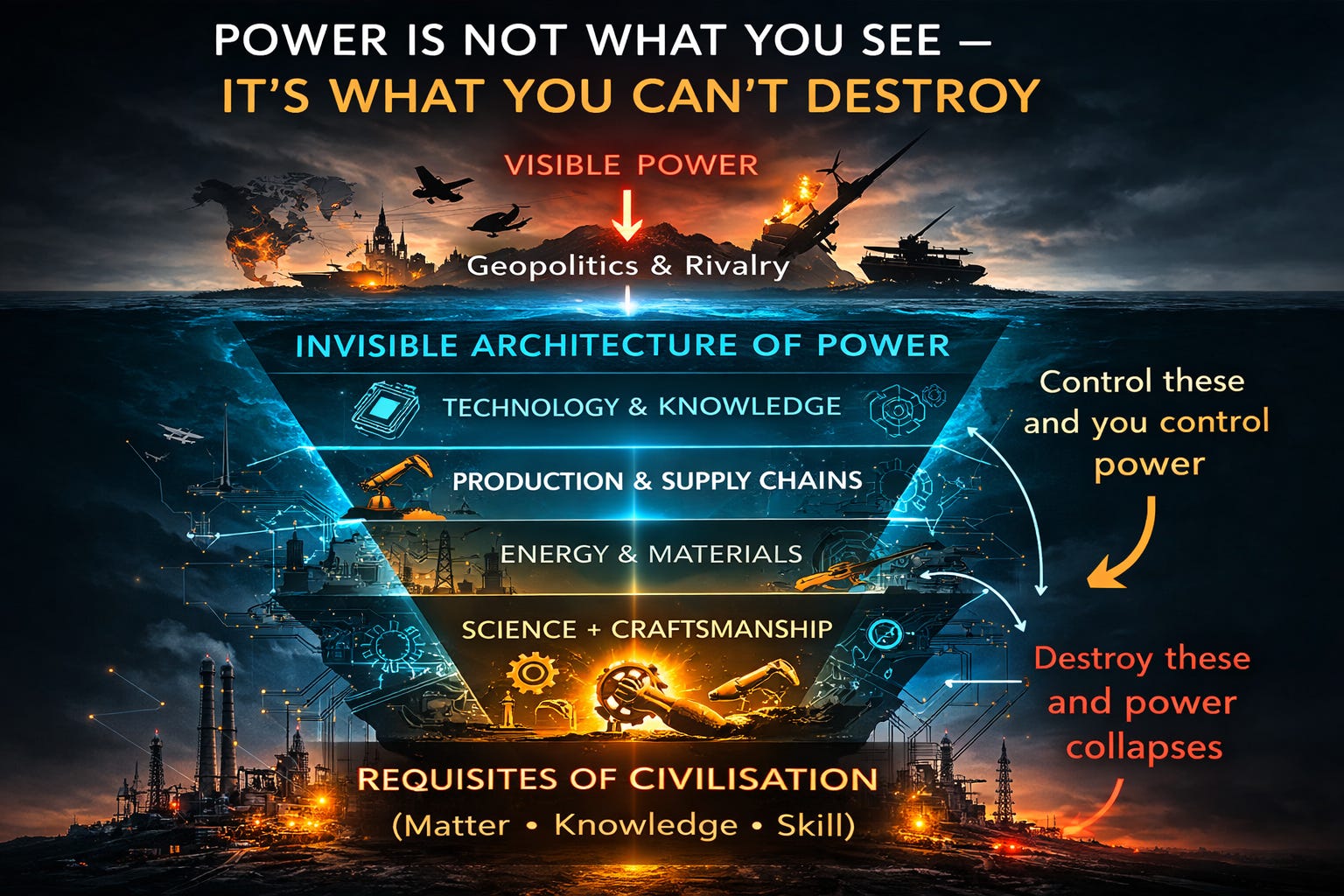
4. The Invisible Architecture of Power
The strategic consequence of this transformation is profound. Contemporary states depend upon intricate industrial ecosystems that remain largely invisible until they fail.
Energy networks, semiconductor fabrication plants, rare earth processing facilities and global supply chains form the hidden infrastructure upon which modern political authority depends. When these systems operate smoothly they remain unnoticed. When they fracture, the limits of power suddenly become visible.
This hidden infrastructure constitutes what may be described as the invisible architecture of power.
Just as Adam Smith described the “invisible hand” coordinating economic exchange, modern geopolitics operates upon an invisible architecture of industrial and technological systems that sustain the capacity of states to exercise power.
5. Requisite Realism
Requisite Realism proposes that these material and technological requisites constitute the ontological foundation of international power.
Military capability, financial strength and technological innovation ultimately depend upon the ability of states to maintain and replenish the underlying systems that sustain them. The fragility of these systems increasingly constrains geopolitical behaviour.
The central claim of Requisite Realism can therefore be expressed simply:
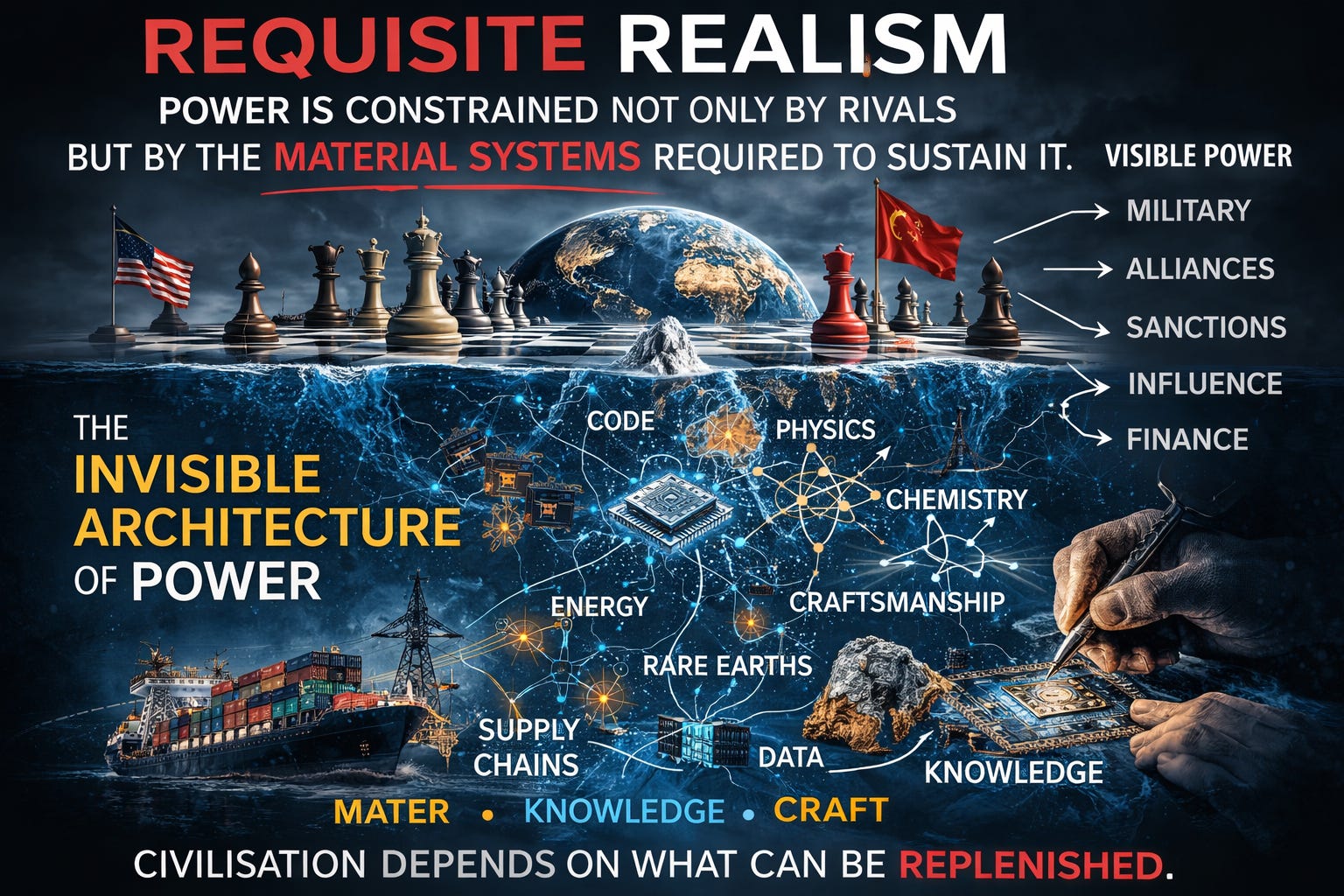
Power is constrained not only by rivals but by the material systems required to sustain it.
Where those systems become fragile or disrupted, the traditional logic of territorial conquest becomes increasingly self-negating.
Axiomatic Premise of Requisite Realism
The argument of Requisite Realism rests on a simple ontological sequence. Political power cannot exist independently of the systems that sustain it. Military force requires logistics. Logistics require industrial production. Production requires material inputs combined with scientific knowledge and skilled labour. These systems depend in turn upon energy, infrastructure and the physical media through which information and finance circulate.
From this perspective, the international system does not begin with anarchy alone. It begins with the material requisites that allow states to exist and to exercise authority.
Where these requisites remain stable, power competition unfolds within the familiar dynamics of realism. Where they become fragile, the pursuit of power risks undermining the very systems that sustain it.
The central axiom of Requisite Realism therefore follows:
Power can only be exercised where the material requisites of industrial civilisation remain intact.
References
Braudel, F. (1981) Civilization and Capitalism, 15th–18th Century. London: Collins.
Mahan, A.T. (1890) The Influence of Sea Power upon History, 1660–1783. Boston: Little, Brown.
Mearsheimer, J.J. (2001) The Tragedy of Great Power Politics. New York: Norton.
Strange, S. (1988) States and Markets. London: Pinter.
Waltz, K.N. (1979) Theory of International Politics. Reading, MA: Addison-Wesley.
“Anarchy does not constrain power; depletion does.”
Traditional realism: Anarchy → security dilemma → power competition
Requisite realism: Material requisites → viable state capacity → political competition
Fukuyama: history ends in liberal order. Mearsheimer: great powers return to rivalry.
Koch: rivalry is constrained by material requisites.
Requisite Realism: A Material Ontology of Power and Enforcement in Contemporary International Relations
Working Paper
Abstract
This paper introduces Requisite Realism as a novel theoretical framework within international relations (IR), re-grounding realism in the material preconditions that enable state power, enforcement, and sovereignty. Extending classical and offensive realism’s emphasis on anarchy, fear, and conquest as mechanisms of order (Mearsheimer, 2001; Waltz, 1979), it argues that these logics presuppose resilient operational requisites—non-substitutable material substrates such as energy, raw materials, infrastructure, food and water, and transmission media—that are increasingly fragile amid global interdependence. Through a series of reductive axioms, the paper demonstrates how these requisites form the ontological foundation underpinning structural power domains of security, production, finance, and knowledge (Strange, 1988). Where coercive actions violate these preconditions, power becomes self-negating, rendering traditional pursuits of geographical hegemony obsolete and qualifying the deterministic escalation posited by the Thucydides Trap (Allison, 2017). Requisite Realism integrates human agency and innovation in reshaping requisites, avoiding material determinism while highlighting a dialectic between structure and ingenuity (Keohane, 1984). Drawing on contemporary geopolitics, including Russia’s stalled enforcement in Ukraine, U.S.-China semiconductor interdependence over Taiwan, Iran’s sanctions-exacerbated crises, Houthi disruptions in the Red Sea, and Venezuela’s autarky failures, the framework illustrates how requisite vulnerabilities foster structural restraint over direct conflict. By reframing anarchy as a derivative abstraction contingent on material stability, Requisite Realism offers predictive leverage for understanding modern rivalries, positioning it as a critical extension of realism in an era of industrial and provisioning complexity. This ontology challenges IR scholars to prioritise sustainment and replenishment, providing a lens for theoretical debates on realism’s evolution (Slenzok, 2025; Woldearegay, 2024).
1. Introduction
International relations theory has long been dominated by realist paradigms that emphasise the tragic necessities of power politics under anarchy. From Thucydides’ ancient account of the Peloponnesian War to modern structural realists, the field has portrayed global affairs as a realm where states, driven by fear and self-interest, compete relentlessly for security and dominance (Allison, 2017; Mearsheimer, 2001). Classical realism underscores the human elements of ambition and uncertainty, while neorealism abstracts these into systemic constraints imposed by the anarchic structure of the international system (Waltz, 1979). Offensive realism, in particular, posits that rational states will pursue aggressive expansion to achieve regional hegemony, viewing conquest as a viable, if tragic, path to survival (Mearsheimer, 2001).
Yet, as the global order evolves into one characterised by deep economic interdependence, technological complexity, and ecological vulnerabilities, these frameworks increasingly appear insufficient. They assume a world where power is measured primarily by deployable capabilities—military might, territorial control, and relative balances—without fully interrogating the underlying conditions that make such power operable and sustainable. In an era where supply chains span continents, digital networks enable instantaneous feedback, and critical resources like rare earth minerals dictate industrial endurance, the constraints on state behaviour shift from relational dynamics to material preconditions.
This paper advances Requisite Realism as a response to this theoretical lacuna. Requisite Realism does not reject realism’s core ontology of anarchy and self-help; rather, it relocates the master constraint within that ontology from external opposition or intentional mistrust to the operational requisites required for power’s enforcement and reproduction. These requisites—energy, raw materials, food and water, infrastructure and logistics, and physical storage and transmission media—constitute the ontological substrate of international order. They are non-substitutable in their functional roles, though human agency and innovation can diversify sources over time, introducing a dialectic that enriches the framework (Keohane, 1984).
Building on Susan Strange’s structural power theory, which identifies security, production, finance, and knowledge as key domains of systemic influence (Strange, 1988), Requisite Realism posits these structures as contingent upon prior material stability. Coercive actions that disrupt requisites—whether through war, sanctions, or sabotage—become self-negating, eroding the very foundations of enforcement faster than they yield strategic gains. This insight qualifies offensive realism’s telos of geographical hegemony and complicates the Thucydides Trap’s prediction of inevitable great-power war (Allison, 2017), as mutual dependencies foster restraint.
The paper proceeds as follows. Section 2 reviews the theoretical gap in existing realism, drawing on recent critiques (Slenzok, 2025). Section 3 outlines Requisite Realism’s ontological foundations through reductive axioms. Section 4 explores the breakdown of conquest logic in globally provisioned systems, incorporating agency to counter determinism. Section 5 re-examines sovereignty and the exception in light of requisite fragility (Schmitt, 1922). Section 6 applies the framework to contemporary case studies, demonstrating its explanatory power. Section 7 discusses implications, predictions, and counterclaims, engaging with symbiotic realism and other developments (Al-Azm, 2025). The conclusion reflects on Requisite Realism’s challenge to IR theory.
2. The Theoretical Gap: Material Assumptions in Realism and Beyond
Realism’s enduring appeal lies in its unflinching confrontation with the harsh realities of international politics. Classical realists like Hans Morgenthau viewed power as an inescapable drive rooted in human nature, while structural variants abstracted this to systemic imperatives (Morgenthau, 1948; Waltz, 1979). Offensive realism sharpens this further, arguing that anarchy compels states to maximise relative power, pursuing regional hegemony through offensive strategies whenever feasible (Mearsheimer, 2001). In this view, great powers’ ultimate goal is to dominate their geographical spheres, preventing peers from achieving similar status elsewhere.
Recent critiques, however, highlight offensive realism’s limitations in modern geopolitics. Slenzok (2025) argues that Mearsheimer’s framework fails to account for economic interdependencies that render aggressive expansion counterproductive, echoing broader debates on realism’s adaptability (Woldearegay, 2024). Similarly, Schuett (2025) warns against pure realism devoid of ideals, suggesting a need for hybrid approaches in an interconnected world.
Structural power theory offers a partial corrective, shifting focus from relational capabilities to systemic structures that shape global rules (Strange, 1988). Strange’s four pillars—security, production, finance, and knowledge—reveal power as embedded in everyday frameworks rather than brute force alone. Yet, even this approach assumes material sufficiency as a background condition, rarely theorising the physical substrates that enable these structures.
This oversight is acute in contemporary conditions. Globalisation has externalised provisioning, making states reliant on transnational flows for essentials. Climate pressures, resource scarcity, and technological chokepoints further erode the resilience once assumed in realist models. As Besada and Abdelhadi (2026) note in their analysis of the US-China minerals race, power now hinges on ‘elemental sovereignty’—control over critical inputs—rather than territorial expanse.
Requisite Realism bridges this gap by elevating material requisites to ontological primacy. It retains realism’s tragic worldview but updates its causal hierarchy: from interactive security dilemmas (Jervis, 1978) to structural dilemmas of asymmetric dependence. In doing so, it integrates political economy, reuniting security studies with the material foundations of endurance (Buzan, 1991).
3. Ontological Foundations of Requisite Realism: Reductive Axioms and Hierarchical Ordering
At its core, Requisite Realism posits that state power is constrained not by ambition or external balances but by the requisites sustaining its enforcement. These requisites are non-substitutable in function, specific properties like conductivity in rare earths cannot be instantly replicated, though diversification via innovation mitigates short-term vulnerabilities.
The framework’s logic derives from five reductive axioms, building deductively from material priority:
Axiom 1: Material Priority. No structure of power exists without a material substrate. Power is instantiated physically, not abstractly.
Axiom 2: Knowledge Requires Physical Cognition. Knowledge depends on biological cognition, symbolic inscription, storage media, and energy-powered transmission, all materially grounded.
Axiom 3: Production Requires Inputs. Production necessitates extractable matter, energy conversion, tools, labour, and infrastructure.
Axiom 4: Security Requires Sustainment. Coercive capacity demands fuel, supply chains, maintenance, and human sustainment.
Axiom 5: Finance Requires Material Settlement. Financial systems rely on expectations of material delivery; without it, symbolic power unravels.
These axioms reveal a vertical hierarchy:
Material Requisites
↓
Security | Production | Finance | Knowledge
↓
Political Behaviour and Enforcement
This ordering extends Strange (1988), positioning requisites as the condition of possibility. Anarchy, far from foundational, emerges as derivative: operative only among materially viable units (Waltz, 1979). Disruptions at the base cascade upward, as in energy shortages triggering financial instability.
Recent theoretical developments, such as symbiotic realism, align with this by emphasising interdependence in global and space orders (Al-Azm, 2025). Requisite Realism thus provides a structural reinterpretation, where power is measured by replenishment velocity rather than deployable force.
4. Global Provisioning, Self-Negating Coercion, and the Role of Agency
In a globally provisioned world, coercion undermines its own requisites, inverting classical conquest logic. Traditional realism assumed separable enemies and national provisioning; today, transnational chains make disruption self-inflicted. Enforcement failure manifests through eroded obedience, materially not ideologically, as shortages affect soldiers and civilians alike.
The ‘Spider Trap’ Koch (2026) extension illustrates this: Dominant states constrain rivals via production webs, making war counterproductive. Yet, Requisite Realism avoids determinism by incorporating agency. Human ingenuity through technological substitution or recycling can reshape requisites, as in US efforts to leapfrog China’s mineral dominance (Council on Foreign Relations, 2026). This dialectic, inspired by Keohane (1984), enriches the ontology: Materials constrain, but ideas transform.
Critiques of reductionism are addressed by this integration, ensuring the framework captures generative power in knowledge content while grounding it materially.
5. Critiquing Offensive Realism and the Thucydides Trap: From Geographical Hegemony to Replenishment Deterrence
Offensive realism’s prediction of relentless expansion falters when requisites render hegemony self-defeating. Mearsheimer (2001) views geographical control as the telos; Requisite Realism negates this structurally, as industrial depth determines endurance (Slenzok, 2025).
The Thucydides Trap, where rising powers provoke war (Allison, 2017), is qualified: Mutual requisite dependencies, shared supply chains, create replenishment deterrence, shifting rivalry to non-kinetic domains like technology restrictions. Recent analyses critique offensive realism for overlooking economic realities in multipolar settings (Woldearegay, 2024).
Requisite Realism reframes the debate: Power transitions produce structural competition, not inevitable conflict, as self-negation incentivises restraint.
6. Contemporary Geopolitics: Case Studies in Requisite Constraint
Requisite Realism’s utility shines in empirical application.
Russia-Ukraine: Provisioning Erosion and Stalemate
Russia’s 2022 invasion sought conquest but encountered requisite failure by 2025-2026. Gains were negligible—0.8% of Ukrainian territory in 2025, with advances like Pokrovsk at metres daily (Al Jazeera, 2026). Sanctions inflated costs, eroding military sustainability (Gould-Davies, 2023; Guardian, 2025). Hybrid escalations, including sabotage, reflect desperation as provisioning disruptions negate enforcement (RUSI, 2025). Here, global energy rerouting undermined Russia’s rear, illustrating self-negating coercion.
US-China Taiwan Tensions: Semiconductor Interdependence and Elemental Sovereignty
Taiwan’s 62% dominance in advanced chips embodies Elemental Sovereignty (Koch, 2025) where requisite control deters invasion (Besada and Abdelhadi, 2026). A conflict could cost $10 trillion globally, severing auto, AI, and smartphone chains (Bloomberg, 2026; Insurance Journal, 2026). US responses, CHIPS Act and $250 billion Taiwanese investments, diversify without escalation (Reuters, 2026). Requisites mitigate the Thucydides Trap through mutual vulnerability.
Iran Sanctions, water crisis and the Disruption of Gulf Requisites
U.S. sanctions targeting Iran’s oil exports, shipping fleet and missile programmes intensified structural pressures already created by a prolonged drought and severe water shortages (Steptoe, 2026; Brookings, 2025). By the mid-2020s, groundwater depletion, electricity shortages and agricultural failures had begun to undermine Iran’s domestic sustainment systems. Water scarcity contributed to energy blackouts, protests and declining agricultural output, revealing how environmental stress can erode the internal requisites of state stability.
Yet Iran’s strategic response demonstrates an equally important dynamic. Rather than confronting superior military power directly, Tehran exploited vulnerabilities in the regional systems upon which Gulf prosperity depends.
Through missile and drone strikes against energy infrastructure, shipping routes and radar installations, Iranian forces and allied groups disrupted ports, refineries, aviation systems and tourism centres across the Gulf. These actions targeted the logistical and economic networks sustaining Gulf economies: oil terminals, desalination facilities, maritime transport corridors and aviation hubs.
The strategic significance of these attacks lies in their systemic effects. The Gulf states rely heavily on imported food, desalinated water and uninterrupted maritime trade. Disruption to energy infrastructure or shipping routes therefore cascades across multiple sectors simultaneously. When conflict in 2026 threatened traffic through the Strait of Hormuz, through which roughly one-fifth of global oil supply normally flows, the result was not merely military confrontation but systemic global economic shock (Steptoe, 2026).
From the perspective of Requisite Realism, this episode illustrates a broader principle. Power competition increasingly occurs not through territorial conquest but through disruption of the material systems that sustain modern economies. Iran’s strategy did not defeat its adversaries militarily, yet by threatening the infrastructure of global energy supply, maritime logistics and desalinated water systems it imposed significant costs across the Gulf order.
The result was a form of strategic equilibrium in which both sides faced vulnerabilities in their respective sustainment systems. Sanctions and drought strained Iran’s domestic requisites, while attacks on shipping, tourism infrastructure, energy infrastructure and desalination networks exposed the fragility of Gulf prosperity. The balance of power therefore shifted not through battlefield victory but through the mutual vulnerability of the infrastructures that sustain the requiites essential to modern states.
Houthi Red Sea Disruptions: Logistical Fragility
Houthi attacks in 2025-2026 raised shipping costs 40%, rerouting $400 billion in trade (World Economic Forum, 2026; Thomson Reuters, 2026). Tied to Gaza, these peripheral actions exposed chokepoints, post-Iran strikes renewing threats (Global Trade Mag, 2026). Major powers’ reliance on these routes highlights requisite fragility over territorial control.
Venezuela Sanctions: Autarky Limits
Maduro’s autarky via Sino-Russia-Iran alliances failed under sanctions, worsening migration and instability (Crisis Group, 2025; Time, 2026). Post-2026 easing of oil bans underscored internalisation’s futility (Hunton, 2026). Requisites negated coercive resilience.
These cases, drawn from 2025-2026 geopolitics, validate Requisite Realism’s emphasis on replenishment over expansion.
7. Implications, Predictions, and Addressing Counterclaims
Requisite Realism generates falsifiable predictions: In rivalries, requisite chokepoints will dominate over territory, with disruptions cascading (Nogimori, 2025). Advantage favours regenerators, as in US attempting recycling innovations (South China Morning Post, 2026).
Counterclaims that powers can internalise requisites via autarky or seizure are empirical tests. Failures like Venezuela refute them, as interdependence accelerates collapse (Economist, 2026).
Implications extend to theoretical debates: Symbiotic realism’s focus on legitimacy in space orders complements this (Al-Azm, 2025), urging IR toward material-political economy hybrids. Symbiotic realism shows how shared infrastructures constrain rivalry in space. Requisite realism shows how material infrastructures constrain power across the entire international system.
8. Conclusion
Requisite Realism re-anchors realism in material reality, showing power’s contingency on requisites. It qualifies anarchy as secondary, integrates agency, and negates conquest’s viability. In US-China dynamics, elemental sovereignty underscores replenishment’s primacy, averting traps through interdependence. This ontology challenges scholars to confront sustainment, fostering nuanced IR theory.
Bibliography
Al Jazeera (2026) ‘Mapping Russian attacks and territorial gains across Ukraine’, Al Jazeera, 24 February. Available at: https://www.aljazeera.com/news/2026/2/24/mapping-russian-attacks-and-territorial-gains-across-ukraine
Al-Azm, N. (2025) ‘Symbiotic Realism: The Future of The Global Order on Earth and in Space’, E-International Relations, 1 December. Available at: https://www.e-ir.info/2025/12/01/symbiotic-realism-the-future-of-the-global-order-on-earth-and-in-space
Allison, G. (2017) Destined for war: can America and China escape Thucydides’s trap? Boston: Houghton Mifflin Harcourt.
Asia Times (2026) ‘China unfazed as US rallies global critical minerals bloc’, Asia Times, 17 February. Available at: https://asiatimes.com/2026/02/china-unfazed-as-us-rallies-global-critical-minerals-bloc
Besada, H. and Abdelhadi, N. (2026) ‘The new critical minerals race – why the US-China rivalry will be decided in the global south’, LSE Business Review, 2 March. Available at: https://blogs.lse.ac.uk/businessreview/2026/03/02/the-new-critical-minerals-race-why-the-us-china-rivalry-will-be-decided-in-the-global-south (
Bloomberg (2026) ‘The $10 Trillion Fight: Modeling a US-China War Over Taiwan’, Bloomberg, 11 February. Available at: https://www.bloomberg.com/news/articles/2026-02-10/the-10-trillion-fight-modeling-a-us-china-war-over-taiwan
Brookings (2025) ‘Can sanctions change the course of conflict?’, Brookings, 17 December. Available at: https://www.brookings.edu/articles/can-sanctions-change-the-course-of-conflict
Buzan, B. (1991) People, states and fear: an agenda for international security studies in the post-cold war era. 2nd edn. Boulder, CO: Lynne Rienner Publishers.
Council on Foreign Relations (2026) Leapfrogging China’s critical minerals dominance. New York: CFR. Available at: https://www.cfr.org/reports/leapfrogging-chinas-critical-minerals-dominance
Crisis Group (2025) ‘10 Conflicts to Watch in 2026’, Crisis Group, 31 December. Available at: https://www.crisisgroup.org/cmt/global/10-conflicts-watch-2026
Economist (2026) ‘America’s dangerous pursuit of critical-mineral dominance’, The Economist, 26 February. Available at: https://www.economist.com/leaders/2026/02/26/americas-dangerous-pursuit-of-critical-mineral-dominance
Global Trade Mag (2026) ‘Red Sea Shipping Hopes Derailed After Strikes on Iran’, Global Trade Mag, 1 March. Available at: https://www.globaltrademag.com/red-sea-shipping-hopes-derailed-after-strikes-on-iran
Gould-Davies, N. (2023) ‘Russia’s War Economy: Myths and Realities’, Survival, 65(3), pp. 7–28.
Guardian (2025) ‘Putin must accept Trump’s deal. Russia’s economy can’t sustain his Ukraine war’, Guardian, 7 December. Available at: https://www.theguardian.com/commentisfree/2025/dec/07/putin-accept-trump-deal-russia-economy-ukraine-war
Hunton (2026) ‘US Eases Venezuela Sanctions Through New General Licenses and FAQs’, Hunton, 13 February. Available at: https://www.hunton.com/insights/legal/us-eases-venezuela-sanctions-through-new-general-licenses-and-faqs
Insurance Journal (2026) ‘The $10 Trillion Fight: Modeling a US-China War Over Taiwan’, Insurance Journal, 12 February. Available at: https://www.insurancejournal.com/news/international/2026/02/12/857770.htm
Jervis, R. (1978) ‘Cooperation under the security dilemma’, World Politics, 30(2), pp. 167–214.
Keohane, R.O. (1984) After hegemony: cooperation and discord in the world political economy. Princeton: Princeton University Press.
Koch, A. (2025) Elemental Sovereignty https://substack.com/home/post/p-168606727
Koch, A. (2026) Thucydides Trapped https://substack.com/home/post/p-189474975
Mearsheimer, J.J. (2001) The tragedy of great power politics. New York: W.W. Norton & Company.
Morgenthau, H.J. (1948) Politics among nations: the struggle for power and peace. New York: Alfred A. Knopf.
Nogimori, M. (2025) ‘The US-China rivalry is exacerbating the critical minerals problem’, JRI Research Journal, 8(6), pp. 1–14. Available at: https://www.jri.co.jp/en/MediaLibrary/file/english/periodical/jrirj/2025/06/nogimori.pdf
Reuters (2026) ‘US and Taiwan reach trade deal, with semiconductor chips and China in focus’, Reuters, 16 January. Available at: https://www.reuters.com/world/china/us-taiwan-reach-trade-deal-focused-semiconductors-commerce-department-says-2026-01-15
RUSI (2025) ‘Russia is Losing – Time for Putin’s 2026 Hybrid Escalation’, RUSI, 19 December. Available at: https://my.rusi.org/resource/russia-is-losing-time-for-putins-2026-hybrid-escalation.html
Schmitt, C. (1922) Political Theology. Munich: Duncker & Humblot.
Schuett, R. (2025) ‘Political Realism and Political Idealism, 2026’, Global Policy, 8 December. Available at: https://www.globalpolicyjournal.com/blog/08/12/2025/political-realism-and-political-idealism-2026
Slenzok, N. (2025) ‘What is Wrong with Mearsheimer’s Offensive Realism?’, Analyse & Kritik, 47(1), pp. 45-68. Available at: https://www.analyse-und-kritik.net/Dateien/6926cae5b1a9e_slenzok–what-is-wrong-with-mearsheimers-offensive-realism.pdf
South China Morning Post (2026) ‘US to counter China’s critical minerals dominance with ‘game-changing’ innovations’, SCMP, 10 March. Available at: https://www.scmp.com/news/china/diplomacy/article/3346024/us-counter-beijings-critical-minerals-dominance-game-changing-innovations
Steptoe (2026) ‘Sanctions Update: March 2, 2026’, Steptoe, 2 March. Available at: https://www.steptoe.com/en/news-publications/stepwise-risk-outlook/sanctions-update-march-2-2026.html
Strange, S. (1988) States and markets. London: Pinter Publishers.
Thomson Reuters (2026) ‘The 2026 supply chain challenge: Global trade disruption’, Thomson Reuters, 12 February. Available at: https://tax.thomsonreuters.com/blog/2026s-supply-chain-challenge-confronting-complexity-and-disruption-in-global-trade-tri
Time (2026) ‘More Than Meals: How Cuts to Food and Agriculture Programs in Latin America Undermine U.S. Policy’, Time, undated. Available at: https://time.com/7340252/venezuela-oil-tanker-trump-machado-maduro/
Union-Bulletin (2026) ‘War is pushing Iran’s water supply to the brink of collapse’, Union-Bulletin, 12 March. Available at: https://www.union-bulletin.com/news/world/war-is-pushing-iran-s-water-supply-to-the-brink-of-collapse/article_f60c06e5-f2e0-5358-ae41-e979d0f2be9f.html
Waltz, K.N. (1979) Theory of international politics. Reading, MA: Addison-Wesley.
Woldearegay, T. (2024) ‘An offensive realism approach to navigate the changing dynamics of summit-level dialogue between the AU and great powers’, Cogent Social Sciences, 10(1), pp. 1-18. Available at: https://www.tandfonline.com/doi/full/10.1080/23311886.2024.2306706
World Economic Forum (2026) ‘Global Supply Chains Enter Era of Structural Volatility, World Economic Forum Report Finds’, World Economic Forum, 19 January. Available at: https://www.weforum.org/press/2026/01/global-supply-chains-enter-era-of-structural-volatility-world-economic-forum-report-finds
You are welcome to share this work with attribution. No commercial or modified uses allowed without permission.
© 2025 Alan Koch.
This work is licensed under a Creative Commons Attribution-NonCommercial-NoDerivatives 4.0 International License.
Alan, congratulations on getting the framework into a working paper. I've been watching these ideas develop through our conversations and your earlier pieces on elemental sovereignty and the spider trap, and it's nice to see them formalised.
Your central axiom is apt for the situation we now find ourselves in. I'm working on an essay about the Gulf War's second and third-order effects, and what strikes me is how precisely the Hormuz closure illustrates requisite fragility in real time — sulfur, semiconductors, fertiliser, all running through a single narrow chokepoint. The system isn't failing because of a military defeat. It's failing because the architecture was designed for efficiency, not resilience. Your framework explains why that design choice was inevitable, not just unfortunate.
One question your essay raises for me that I haven't resolved: if requisite realism predicts that coercion becomes self-negating in a globally provisioned world, what happens when the coercing power doesn't care about the self-negation? When the decision-maker treats the material costs as someone else's problem — the Gulf's problem, Europe's or Asia’s problem, the next administration's problem? Does requisite realism assume rational state actors, and if so, what happens when that assumption fails?
I may link to your work from my essay when it publishes. More soon.
Good article Alan - by coincidence I have a paper coming out soon that touches on this….