VOLTS or BUTTER

As artificial intelligence and electrification reshape growth, the decisive economic constraint is no longer capital or trade policy but access to abundant, reliable electricity.
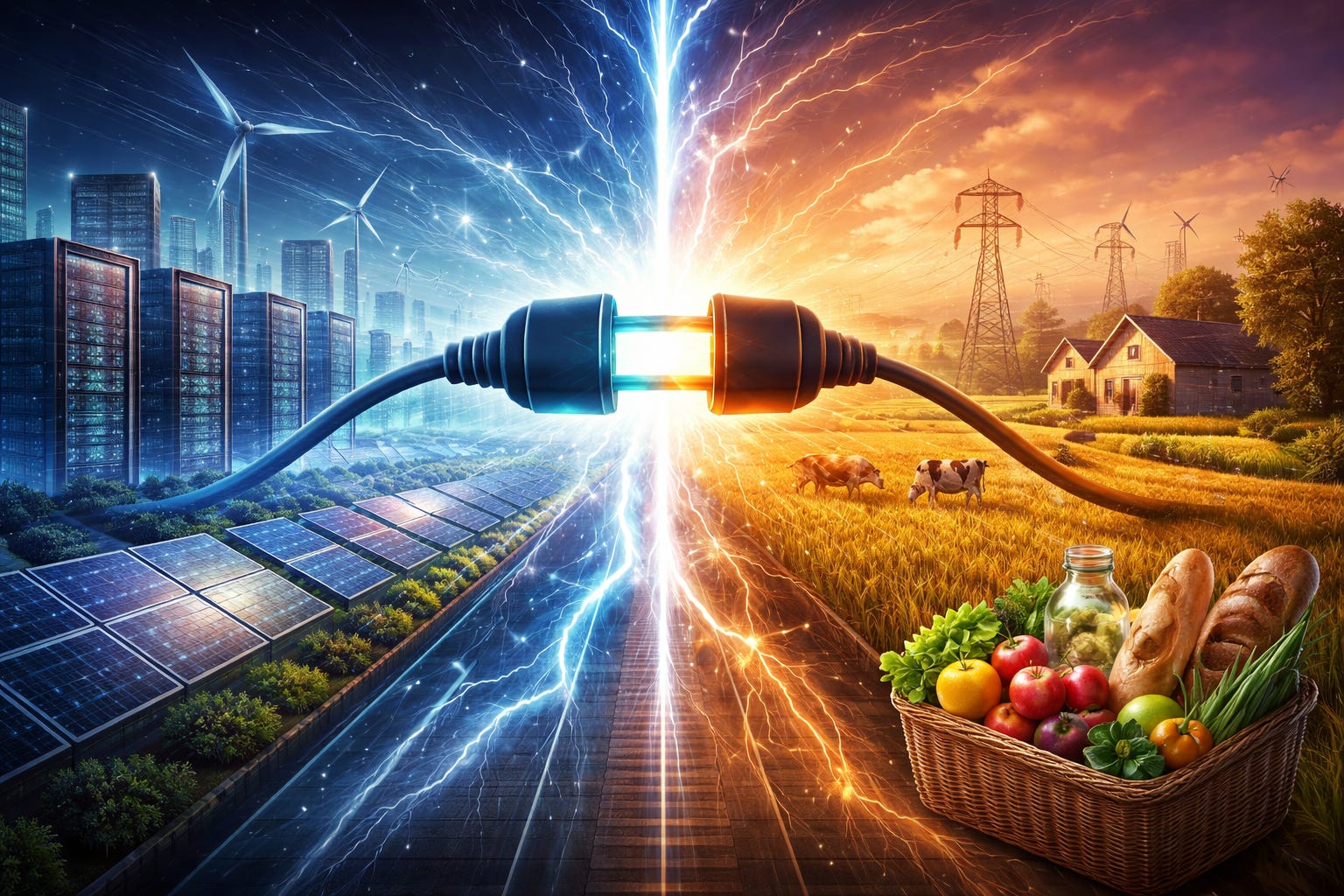
For most of the postwar period, debates about economic power revolved around money: fiscal space, interest rates, deficits and markets. Today that lens is increasingly inadequate. In the emerging AI and automation-driven economy, the binding constraint is no longer capital but electricity. Prosperity now depends less on balance sheets than on access to abundant, reliable power.
This shift helps explain a growing divergence between China and the United States that tariffs, subsidies and monetary policy have so far failed to arrest.
Spend time in China and one notices a striking feature of recent development: scale without visible strain. New urban districts appear fully connected from the outset. Electric vehicles move rapidly from niche to default. Data centres proliferate without the local opposition and grid bottlenecks familiar elsewhere. At night, entire skylines illuminate simultaneously, not as spectacle but as routine commissioning.
To an outsider, this can look wasteful. In fact, it reflects a different institutional choice. Electricity in China is treated as core infrastructure, planned and built ahead of demand. Capacity is deliberately overprovided, prices are policy-mediated, and reliability takes precedence over short-term returns. Power functions as a public good in practice, even where utilities are corporatised.
That choice has compounding effects. Cheap, predictable electricity lowers the cost of experimentation, automation and learning. Data centres can scale without bidding wars against households. Factories can electrify processes aggressively. New technologies diffuse quickly because energy is not a choke point. When AI models are trained or deployed, the constraint is engineering, not the power bill.
The contrast with the US is stark. Electricity supply is fragmented, privately financed and slow to expand. New capacity must clear regulatory, political and financial hurdles. Large users often pay not only for the power they consume but also for the infrastructure required to deliver it. As a result, electricity becomes a strategic bottleneck. Growth in compute, manufacturing and even housing increasingly runs into grid limits.
This difference helps explain several puzzles in today’s policy debate.
First, tariffs have failed to contain China’s export surge. Supply chains reroute easily when energy-intensive production remains cheaper upstream. Final assembly can move; learning and scale do not. Second, industrial subsidies in the west struggle to generate durable advantages when firms face high operating costs once support expires. Third, monetary easing inflates asset prices rather than productivity when the real economy cannot absorb liquidity through expanded capacity.
The same logic applies to artificial intelligence. Western hyperscalers have poured capital into data centres on the assumption of future rents. Consumer subscriptions alone cannot plausibly cover the electricity, hardware and depreciation involved. If expectations reset, valuations may fall. But the underlying capability does not disappear. Once built, productive systems continue to operate; only the pace of expansion changes.
Where electricity is cheap and publicly provisioned, that normalisation is far less disruptive. Compute continues to run, models are reused, and learning compounds. Where electricity is scarce and expensive, expansion slows just as global competition accelerates.
This is why the twentieth-century framing of guns versus butter no longer captures reality. Military power, industrial competitiveness and civilian welfare now all depend on the same foundation: access to electrons. The real trade-off has become volts versus butter. Countries that treat power as strategic infrastructure can make those goals complementary. Countries that treat power as a commodity are forced into zero-sum choices.
The implication is uncomfortable but clear. No amount of financial engineering can substitute for missing capacity. Tariffs cannot compensate for higher energy costs. Interest-rate cuts cannot create productivity where grids are constrained. In the AI age, sovereignty is measured less by market capitalisation than by sustained gigawatts of power.
The next phase of global competition will be decided not on trading floors alone, but in planning commissions, grid maps and power stations. Until policymakers recognise that electricity is the new foundation of growth, debates about markets and money will continue to miss the point, brightly argued, but dimly powered.
I reckon you have nailed it.